
Product reviews / Natural-hair flat irons
Best Flat Irons for Natural Hair: 6 Detailed Reviews
Six flat irons for occasional natural-hair straightening, reviewed for section contact, adjustable controls, root access and shaping the ends.

As an Amazon Associate I earn from qualifying purchases, at no extra cost to you. Affiliate disclosure

Controlled small-section straightening
THE SHORTLIST
Choose the tool for your routine
For occasional straightening of chemically untreated curls and coils, BaBylissPRO Digital offers controlled narrow-panel work; Remington’s two-inch plates favor long prepared lengths.
BaBylissPRO Nano Titanium Digital 1-inch
Controlled small-section straightening
Remington Shine Therapy 2-inch
Broad contact on long prepared lengths
Conair Double Ceramic 1-inch
A simple five-setting routine

VANESSA PRO 1-inch Titanium Iron
Straight lengths with softly curved ends

TYMO SWAY 1-inch Champagne Iron
Frequent changes of temperature setting

Revlon Ceramic Coated 2-inch Iron
Simple broad-length straightening
THE EDITOR'S TAKE
Where these tools fit
For occasional straightening of chemically untreated curls and coils, BaBylissPRO Digital offers controlled narrow-panel work; Remington’s two-inch plates favor long prepared lengths.
Natural describes texture and chemical treatment, not heat tolerance. Fine strands, worn ends and previous heat damage still change the setting and the decision to straighten.
A smooth result starts with detangling and completely dry, organized sections. No plate material makes repeated reheating a harmless daily routine.
A CLOSER LOOK
The full product reviews
BaBylissPRO Nano Titanium Digital 1-inch
The most useful starting point here for a deliberate natural-hair routine: a readable setting, narrow plate access and a memory function that needs checking before every session.
A thin panel matters more than a high setting
The one-inch plate width is useful when you want to keep a natural curl section organized rather than flatten the outside of a thick bundle. Divide a fully detangled, dry section so the plate faces contact an even layer. If the underside stays textured, reduce the section instead of immediately raising the temperature. The floating construction accommodates contact as the tool closes, but it cannot distribute an overloaded section for you.
Memory is convenient until your hair changes
The digital iron saves a preferred setting. That removes a repeated adjustment for an occasional straightening session, while also creating a reason to read the display each time. Freshly colored lengths, weathered ends and newly grown roots need not tolerate the same heat. Use the controls to reflect strand condition rather than choosing a setting because the curl pattern looks tight. Titanium describes the plate material; it is not a prescription to use the maximum.
Keep the finish intentional
A one-inch tool leaves room to turn the ends slightly without flattening every section against the head. At the root, leave safe clearance from skin and maintain a clear view of the plate edge. Once the style is complete, let it cool and protect it from unnecessary moisture. Repeated touch-ups whenever humidity changes can turn an occasional styling choice into frequent reheating. Choose this model for its controls and manageable width, rather than treating saved settings as a guarantee of curl recovery.
What stands out
- One-inch floating plates suit controlled panels and curved ends.
- The digital display makes a saved setting easy to check.
The trade-offs
- Temperature memory can retain a setting that no longer suits fragile ends.
Our verdict The most useful starting point here for a deliberate natural-hair routine: a readable setting, narrow plate access and a memory function that needs checking before every session.
Using it in your routine
Detangle and dry completely, divide into thin panels, check the displayed setting and guide each section without pausing against the hair.
Consider another option if: Choose a lower-heat styling approach if your lengths are already breaking or cannot tolerate hot-tool styling.
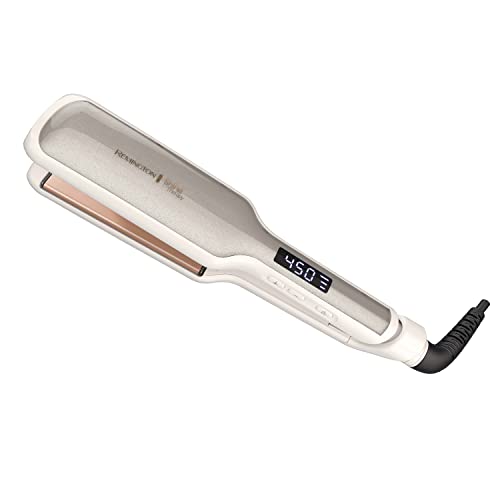
Remington Shine Therapy 2-inch
A wide-plate option for long lengths that are already detangled and stretched, with less appeal for short roots and precise end shaping.
Width helps only after preparation
The S9531 is the wide Shine Therapy version, so its strongest role is the main lengths rather than tiny hairline sections. Lay a dry, detangled panel flat across the plates and keep the amount of hair manageable. A wide plate can cover a broad ribbon of hair; it cannot reliably press the inner layers of a thick rolled-up bundle. Preparation remains the step that makes the contact useful.
The plate treatment is not a hair treatment
Remington describes ceramic plates infused with argan oil and keratin. That is part of the tool construction, not permission to add oil immediately before pressing or a substitute for conditioning. The nine-setting control matters more to the practical purchase decision. Start conservatively for your strand condition and use a smaller section if the result is uneven. The turbo option is not an automatic next step for tight curls.
Roots and ends need a separate decision
The broad face is easiest to justify when most of your work is on long, prepared lengths. Around ears and short temple hair, the plate edge and surrounding body occupy more space than a one-inch model. Do not force it closer to the scalp to copy the finish on the ends. If your routine combines a root-level finish with a pronounced inward bend, the narrower BaBylissPRO is a more flexible single-tool choice. The Remington earns its place when broad coverage is the priority.
What stands out
- Wide ceramic plates give a broad contact surface.
- Nine settings let you adjust the tool rather than accept one fixed temperature.
The trade-offs
- The two-inch body is less convenient beside short regrowth and a curved hairline.
Our verdict A wide-plate option for long lengths that are already detangled and stretched, with less appeal for short roots and precise end shaping.
Using it in your routine
Use on dry hair only; keep long panels flat, select an appropriate setting and avoid packing extra layers between the plates.
Consider another option if: Skip a two-inch plate if your main task is short root detail or a very short haircut.
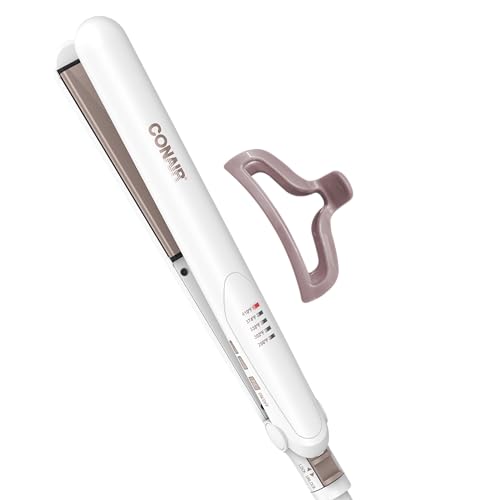
Conair Double Ceramic 1-inch
A straightforward narrow iron for someone who wants a small number of choices and enough plate access to work around shorter natural lengths.
A small menu can be useful
The CS221AMZ uses five heat settings instead of a long sequence of temperature increments. That suits a routine where you settle on an appropriate level and concentrate on section placement. The limitation is the distance between the choices: a lower setting and the next one up are not the same as a continuously adjustable dial. Do not keep escalating through them simply because the outside of a large section looks smoother than the underside.
Long plates still need a flat section
The one-inch width leaves more maneuvering room than the wide Remington, while the extra-long face can support a longer ribbon of hair. Keep that ribbon evenly distributed from edge to edge. Detangled ends should enter the tool without bunching at the hinge, and short pieces should be separated from the longer section rather than trapped underneath it. The supplied sectioning clip is useful for keeping the next panel away from the active one.
A practical choice for occasional shaping
This is a sensible format when you straighten occasionally and want to finish the ends with a gentle turn. It is less compelling if you need very fine setting increments for multiple zones with different levels of damage. The ceramic coating is a feature of the plate, not evidence that any setting is harmless. Match the heat to the weakest part of the section, and stop when the tool requires repeated corrective passes to achieve the finish.
What stands out
- One-inch extra-long floating plates suit narrow panels.
- Five settings keep the heat-selection routine straightforward.
The trade-offs
- Five preset choices give less fine adjustment than a wider digital range.
Our verdict A straightforward narrow iron for someone who wants a small number of choices and enough plate access to work around shorter natural lengths.
Using it in your routine
Separate a dry panel with the sectioning clip, start with a suitable low setting and keep the ends aligned before closing the plates.
Consider another option if: Choose more finely adjustable controls if small setting changes are essential to your routine.
VANESSA PRO 1-inch Titanium Iron
A narrow titanium tool for a straight finish that still needs movement at the ends; use its adjustable range rather than the one-pass promise to make the choice.
Straightening without losing the end shape
The LM-115 is a one-inch iron with rounded edges. That format is useful when the desired finish is smooth lengths with a soft bend, rather than a rigid sheet of hair. Guide a thin dry panel down the plates, then turn the tool only where the bend should begin. A long section needs room to stay untwisted behind the iron. Pulling it taut and rotating too early changes the finish along the entire length.
Treat the range as a set of choices
The listed adjustable range starts at 265°F and reaches 450°F. The upper limit is not a target for natural hair, and chemically untreated hair can still have fragile ends or prior heat damage. Choose for condition and section contact first. The brand markets fast one-pass styling, but a useful routine does not depend on forcing a thick panel through once. If contact is uneven, address the preparation and panel size before adding heat.
A narrow tool has a clear trade-off
Compared with a two-inch iron, this model asks you to work through more narrow panels on very long, dense hair. In return, it gives more room to approach short sections and refine the final curve. That exchange is worth making if shaping matters as much as broad coverage. Keep the controls visible, place the hot tool on a suitable surface between sections and switch it off yourself after styling. Automatic shutoff does not replace an intentional finish to the routine.
What stands out
- The narrow rounded format suits straightening and end shaping.
- The listed heat range allows a conservative starting point.
The trade-offs
- Automatic shutoff is a backup; finish each session by switching off and unplugging the iron yourself.
Our verdict A narrow titanium tool for a straight finish that still needs movement at the ends; use its adjustable range rather than the one-pass promise to make the choice.
Using it in your routine
Work through evenly detangled dry panels and reserve the final wrist turn for the ends you want to bend. Switch off and unplug after use.
Consider another option if: A wide plate may suit you better if almost all your styling is broad, straight work on long lengths.
TYMO SWAY 1-inch Champagne Iron
- Plate width
- 1 inch
- Controls
- 32 listed temperature levels
- Finish
- Champagne titanium model
The control-focused alternative when you want many temperature choices in a narrow iron, with a motion-sleep system that deserves familiarization before styling.
The controls are the reason to consider it
This Champagne listing identifies a one-inch titanium SWAY with 32 temperature levels. More choices are useful if you want a small adjustment between sessions, rather than a large jump to the next preset. They do not prove that every numerical setting is equally suitable for your hair. Separate roots and fragile ends in your planning, and read the selected setting before applying the plate to a section.
Understand what happens when you put it down
The listed motion-control system puts the tool into automatic sleep after inactivity and uses movement to reactivate it. In practice, that means the tool behaves differently from a conventional switch-only iron when you pause to divide the next section. Learn the display and readiness indications before a full styling session. Do not press a panel while guessing whether the iron has returned to its selected setting, and do not leave it unattended because it has a sleep feature.
Small panels make the flexibility useful
A narrow floating plate is appropriate for deliberately stretched natural hair when you need control beside shorter lengths. Use the swivel cord to change your approach without twisting the section around the body. The resulting routine can be orderly: separate, confirm the setting, position the panel and guide the tool. The model is less attractive if you prefer a simple iron with no motion behavior to remember. Its useful distinction is adjustment and handling, rather than a promise that tight texture needs extreme heat.
What stands out
- The listing provides 32 heat levels and temperature memory.
- One-inch floating plates leave room for smaller panels.
The trade-offs
- Motion-based sleep and wake controls add behavior to learn before the first session.
Our verdict The control-focused alternative when you want many temperature choices in a narrow iron, with a motion-sleep system that deserves familiarization before styling.
Using it in your routine
Familiarize yourself with the sleep and readiness indicators, then use narrow dry panels and confirm the saved setting before contact.
Consider another option if: Choose a conventional control system if motion wake-up would make your styling routine less predictable.
Revlon Ceramic Coated 2-inch Iron
A basic wide-format choice for prepared long lengths when you do not need memory controls or intricate root work.
Keep its job uncomplicated
The RVST2182 has two-inch ceramic-coated plates and multiple heat settings. That makes it a broad straightening tool, with a clear reason to consider it when your hair is long enough to lay across the face. It is not the strongest choice for changing between short hairline detail, a full straight finish and tight end curves. Decide whether that broad job represents most of your routine before choosing it for the width alone.
A lower ceiling is still hot-tool styling
Revlon lists a 400°F maximum, lower than several other irons here. That number does not make the maximum the right setting for your strands. Dry the hair fully, remove knots and choose an appropriate lower level first. If a panel needs repeated passes, it may contain too many layers or need more preparation. Ceramic coating does not correct that contact problem, and naturally curly hair should not be assigned one heat level regardless of its condition.
Where the simplicity becomes a limitation
There is no memory-setting workflow to build the purchase around. For occasional broad-length pressing, that may be enough; for precise adjustments between different sections, a readable digital iron is easier to evaluate at a glance. Keep the hot edges away from skin around the ears and do not force short pieces into a large panel. Revlon fits a deliberately simple long-hair routine, while the narrower choices make more sense when maneuverability is the main problem.
What stands out
- The broad ceramic-coated plates suit flat long panels.
- Multiple settings allow a lower choice than the maximum.
The trade-offs
- The wide format gives up some close-placement flexibility and detailed digital control.
Our verdict A basic wide-format choice for prepared long lengths when you do not need memory controls or intricate root work.
Using it in your routine
Select a suitable setting, work through dry flattened panels and leave short hairline detail out of broad sections.
Consider another option if: Choose a narrow digital model if root placement and close temperature adjustment dominate your routine.
EVERYDAY DETAILS
What matters in everyday use
Contact before coverage
Choose a width that lets a thin panel lie evenly between the plates. A wide face does not straighten layers it cannot reach.
Condition before curl pattern
Use strand condition, past damage and manufacturer directions to choose settings; never assign heat by race.
Occasional finish
Plan roots, lengths and curved ends separately, then protect the finished style instead of repeatedly pressing humidity changes.
Product photographs: Amazon. Certain content that appears on this site comes from Amazon. This content is provided “as is” and is subject to change or removal at any time.
GOOD TO KNOW
Questions that change the choice
Do I need a hot comb as well?
Not automatically. These are flat irons. A hot comb has a different contact method and is not a substitute recommendation here; choose a separate tool only for a specific task you can perform safely.
Should natural hair be completely dry?
Yes for the dry-hair flat irons in this selection. Detangle and dry thoroughly before contact, including the roots and dense inner layers.
Is a two-inch plate better for coils?
Width follows length and accessible section area. A two-inch iron suits broad long panels; one inch gives more room near short sections. Tight curl pattern alone does not choose the width.
How does this differ from a 4C-specific review?
This selection addresses occasional straightening across untreated curl and coil patterns. A 4C-specific routine needs closer attention to compact sections and preparation; use that dedicated review for those choices.
Bella Ross curates practical hairstyle ideas for everyday cuts, braids, color inspiration, and simple styling routines.
Our editorial policySTYLE IT YOUR WAY
A little styling inspiration
 Product reviews
Flat Irons for 4C Hair: 6 Detailed Reviews
A 4C routine needs clear section access, complete preparation and a heat setting chosen for the hair’s condition. Plate width should improve placement, not encourage thick bundles or extra pressure.
 Product reviews
Flat Irons for 4B Hair: 6 Detailed Reviews
For a 4B straightening routine, plate access and flat, detangled sections matter more than a one-pass claim. Curl pattern alone does not identify the right heat setting for an individual head of hair.
 Product reviews
6 Flat Irons for Black Hair: Detailed Reviews
Black hair encompasses many strand textures, densities and styling preferences. For a stretched or silk-press routine, the distinction is how the tool handles long prepared sections versus small details.