
Product reviews / COMB REVIEWS
6 Combs for Fine Hair: Our Detailed Reviews
Paul Mitchell’s wide-tooth comb is our first choice for detangling; Kent 16T is the more useful all-in-one option when a tidy dry finish also matters. A metal-tail comb belongs in a parting routine rather than the first pass through knots.

As an Amazon Associate I earn from qualifying purchases, at no extra cost to you. Affiliate disclosure

The first detangling pass
THE SHORTLIST
Six options, reviewed in detail
Detangling fine strands without sacrificing a neat finish
Our first pick
Paul Mitchell Detangler Comb
The first detangling pass
Pick 2

Kent 16T Dressing Comb
Detangling and dry finishing
Pick 3

Wet Brush WaveTooth Detangling Comb
Conditioner distribution
Pick 4
Onedor Fine-Tooth Sandalwood Comb
Tidying a dry part
Pick 5

Bardeau Essentials Carbon Pintail Comb
Precise sectioning
Pick 6

SALON SILK Four-Piece Comb Set
Different combs for different steps
THE EDITOR'S TAKE
Our verdict
Paul Mitchell’s wide-tooth comb is our first choice for detangling; Kent 16T is the more useful all-in-one option when a tidy dry finish also matters. A metal-tail comb belongs in a parting routine rather than the first pass through knots.
Fine hair and low density are different concerns. Here the priority is strand handling: start with enough tooth spacing for the section, support the ends and use closer teeth only after knots are gone.
A CLOSER LOOK
The full product reviews
Our first pick
Paul Mitchell Detangler Comb
The open spacing makes it a sensible first pass through ends before a closer finishing comb, especially when you want fewer teeth moving through each section. For fine strands with knots at the ends, start with Paul Mitchell’s open tooth spacing and hold the section above the working area.
Paul Mitchell’s wide-tooth comb is intended for wet or dry detangling and distributing conditioner or masks. The open spacing makes it a sensible first pass through ends before a closer finishing comb, especially when you want fewer teeth moving through each section.
Handling and application
Begin at the lowest knot while supporting the section above it. Short upward progress is more useful than a full root-to-tip stroke that tightens every tangle together. After the ends are clear, extend the working area until the comb can move through the section freely. With Paul Mitchell Detangler Comb, support a section above the tangle, start at the ends and move upward in short passes.
Detangling fine strands without sacrificing a neat finish
For fine strands with knots at the ends, start with Paul Mitchell’s open tooth spacing and hold the section above the working area. The purpose is to clear the ends before smoothing, not to pull every strand into a polished sheet immediately. A separate fine-tooth pass can follow only where the hair moves freely.
The trade-off
Wide teeth are not designed to press every flyaway into a polished part. Even a detangling comb can pull if it meets an untreated knot. Support the section above a knot before working upward from the ends. The wide spacing helps access but does not make a full-length forced stroke appropriate.
What stands out
- Paul Mitchell’s wide-tooth comb is intended for wet or dry detangling and distributing conditioner or masks.
- The open spacing makes it a sensible first pass through ends before a closer finishing comb, especially when you want fewer teeth moving through each section.
The trade-offs
- Wide teeth are not designed to press every flyaway into a polished part. Even a detangling comb can pull if it meets an untreated knot.
Our verdict The open spacing makes it a sensible first pass through ends before a closer finishing comb, especially when you want fewer teeth moving through each section. Wide teeth are not designed to press every flyaway into a polished part.
Using it in your routine
Support a section above the tangle, start at the ends and move upward in short passes.
Consider another option if: Wide teeth are not designed to press every flyaway into a polished part. Even a detangling comb can pull if it meets an untreated knot.
Pick 2
Kent 16T Dressing Comb
You can loosen a section with the wider end and then refine the part or smooth the surface with the fine end, without swapping tools. Kent’s two tooth spacings solve two different jobs on the same comb.
Kent 16T combines fine and wider teeth in one 7.2-inch saw-cut, hand-polished cellulose-acetate comb. You can loosen a section with the wider end and then refine the part or smooth the surface with the fine end, without swapping tools.
Handling and application
Use tooth spacing for the stage of the routine. A wider passage makes sense during preparation; closer teeth belong to finishing a part or smoothing hair that is already free of knots. Changing tools is preferable to forcing a finishing comb through an untreated section. With Kent 16T Dressing Comb, detangle with the wider teeth first; use the fine teeth only where they glide freely.
Detangling fine strands without sacrificing a neat finish
Kent’s two tooth spacings solve two different jobs on the same comb. Use the wider side through the ends, then rotate it for a cleaner dry part. The hand-polished acetate matters as a contact surface; it should not be bought on the listing’s unsupported suggestion that combing prevents hair loss.
The trade-off
The fine side requires already-detangled hair. Claims that combing can prevent hair loss are not a reason to buy a styling comb. Use the wider end first where knots remain, then the closer teeth for the finish. Reversing that sequence asks the dressing teeth to do detangling work.
What stands out
- Kent 16T combines fine and wider teeth in one 7.2-inch saw-cut, hand-polished cellulose-acetate comb.
- You can loosen a section with the wider end and then refine the part or smooth the surface with the fine end, without swapping tools.
The trade-offs
- The fine side requires already-detangled hair. Claims that combing can prevent hair loss are not a reason to buy a styling comb.
Our verdict You can loosen a section with the wider end and then refine the part or smooth the surface with the fine end, without swapping tools. The fine side requires already-detangled hair.
Using it in your routine
Detangle with the wider teeth first; use the fine teeth only where they glide freely.
Consider another option if: The fine side requires already-detangled hair. Claims that combing can prevent hair loss are not a reason to buy a styling comb.
Pick 3
Wet Brush WaveTooth Detangling Comb
It gives you a detangling step that can sit directly inside wash day, before you scrunch and let natural waves set. WaveTooth is useful here as a conditioner-distribution comb rather than a dedicated fine-tooth finisher.
WaveTooth uses rounded, wavy teeth and is designed to distribute conditioner or masks through hair. It gives you a detangling step that can sit directly inside wash day, before you scrunch and let natural waves set.
Handling and application
Conditioner distribution and final styling are different passes. During wash day, work through manageable sections so product reaches the interior. After the shape is arranged, repeated combing changes that shape; decide whether the desired finish is defined clumps or a softer combed-out look. With Wet Brush WaveTooth Detangling Comb, comb conditioned sections from the ends upward; stop combing once the styling clumps are arranged.
Detangling fine strands without sacrificing a neat finish
WaveTooth is useful here as a conditioner-distribution comb rather than a dedicated fine-tooth finisher. Fine strands can still be dense, so divide the hair before the wet pass. Its rounded teeth do not remove the need to stop when one rough end catches.
The trade-off
Using it repeatedly once waves are dry may separate the pattern into a softer, fluffier finish. It does not create a permanent curl pattern. Rinse conditioner from the wavy tooth gaps after wash day. Their rounded shape should stay visible instead of being filled with dried mask residue.
What stands out
- WaveTooth uses rounded, wavy teeth and is designed to distribute conditioner or masks through hair.
- It gives you a detangling step that can sit directly inside wash day, before you scrunch and let natural waves set.
The trade-offs
- Using it repeatedly once waves are dry may separate the pattern into a softer, fluffier finish. It does not create a permanent curl pattern.
Our verdict It gives you a detangling step that can sit directly inside wash day, before you scrunch and let natural waves set. Using it repeatedly once waves are dry may separate the pattern into a softer, fluffier finish.
Using it in your routine
Comb conditioned sections from the ends upward; stop combing once the styling clumps are arranged.
Consider another option if: Using it repeatedly once waves are dry may separate the pattern into a softer, fluffier finish. It does not create a permanent curl pattern.
Pick 4
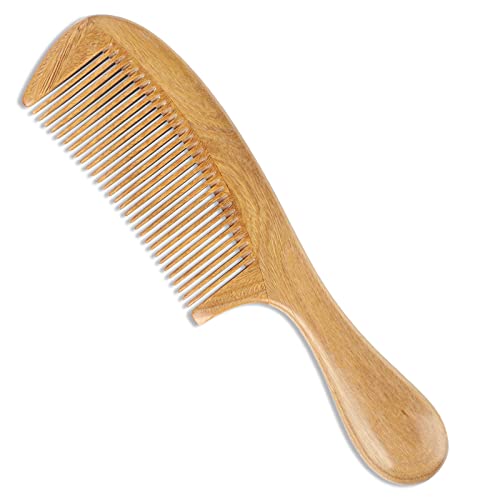
Onedor Fine-Tooth Sandalwood Comb
The handle gives you a clear place to hold the comb while tidying a dry part or smoothing an already-detangled fringe. Onedor belongs after the knots are gone.
This 7-inch handled comb uses green sandalwood and closely spaced teeth. The natural grain means individual combs can look different. The handle gives you a clear place to hold the comb while tidying a dry part or smoothing an already-detangled fringe.
Handling and application
Pay attention to what happens at the last few inches. Rough ends can catch even when the roots glide easily, so pause and separate that area rather than pulling harder at the handle. A comfortable grip helps control a stroke but cannot compensate for poor preparation. With Onedor Fine-Tooth Sandalwood Comb, use on detangled hair in light strokes, clean gently and dry the wooden body before storage.
Detangling fine strands without sacrificing a neat finish
Onedor belongs after the knots are gone. The fine teeth can arrange a dry fringe or part without needing a second handle, but they are the wrong starting point for wet snarls. The wooden body also changes storage: dry it after gentle cleaning instead of leaving it in the shower.
The trade-off
Close teeth are a poor first step through wet knots or tightly clumped waves. Wood needs drying after cleaning rather than being left soaking in a shower.
What stands out
- This 7-inch handled comb uses green sandalwood and closely spaced teeth. The natural grain means individual combs can look different.
- The handle gives you a clear place to hold the comb while tidying a dry part or smoothing an already-detangled fringe.
The trade-offs
- Close teeth are a poor first step through wet knots or tightly clumped waves. Wood needs drying after cleaning rather than being left soaking in a shower.
Our verdict The handle gives you a clear place to hold the comb while tidying a dry part or smoothing an already-detangled fringe. Close teeth are a poor first step through wet knots or tightly clumped waves.
Using it in your routine
Use on detangled hair in light strokes, clean gently and dry the wooden body before storage.
Consider another option if: Close teeth are a poor first step through wet knots or tightly clumped waves. Wood needs drying after cleaning rather than being left soaking in a shower.
Pick 5
Bardeau Essentials Carbon Pintail Comb
The metal tail is useful for drawing a precise part and lifting a narrow section before styling; the fine teeth can then align that section. Bardeau’s metal tail is the reason to choose it.
Bardeau’s 8.8-inch comb pairs fine teeth with a stainless-steel pointed tail. The metal tail is useful for drawing a precise part and lifting a narrow section before styling; the fine teeth can then align that section.
Handling and application
Parting requires a light touch. Use a tail or the end of the comb to separate a line, then lift the hair gently without scraping the scalp. Precision is helpful only when it comes without repeated pressure on the same sensitive area. With Bardeau Essentials Carbon Pintail Comb, use the tail to separate hair gently, then comb only the prepared section without forcing the teeth.
Detangling fine strands without sacrificing a neat finish
Bardeau’s metal tail is the reason to choose it. Draw the part gently, lift a small section and keep the fine teeth for hair that has already been detangled. On fragile strands, repeated backcombing can work against the low-force preparation that this page prioritizes.
The trade-off
It is a sectioning tool rather than a forgiving wide-tooth detangler. A pointed tail should stay clear of the eyes and should not scrape the scalp. The projecting tail is a sectioning point, not a surface to push against the scalp. Keep it separate from the wide-tooth tool used through tangled lengths.
What stands out
- Bardeau’s 8.8-inch comb pairs fine teeth with a stainless-steel pointed tail.
- The metal tail is useful for drawing a precise part and lifting a narrow section before styling; the fine teeth can then align that section.
The trade-offs
- It is a sectioning tool rather than a forgiving wide-tooth detangler. A pointed tail should stay clear of the eyes and should not scrape the scalp.
Our verdict The metal tail is useful for drawing a precise part and lifting a narrow section before styling; the fine teeth can then align that section. It is a sectioning tool rather than a forgiving wide-tooth detangler.
Using it in your routine
Use the tail to separate hair gently, then comb only the prepared section without forcing the teeth.
Consider another option if: It is a sectioning tool rather than a forgiving wide-tooth detangler. A pointed tail should stay clear of the eyes and should not scrape the scalp.
Pick 6
SALON SILK Four-Piece Comb Set
Separate tools let you reserve the wide comb for knots and choose a more precise comb for parting, rather than forcing one tooth spacing to do everything. SALON SILK gives the wide comb and close finishing tools separate roles.
The set includes wide-tooth, rat-tail fine-tooth, medium-tooth and braiding combs. Separate tools let you reserve the wide comb for knots and choose a more precise comb for parting, rather than forcing one tooth spacing to do everything.
Handling and application
A compact set is useful when each tooth spacing has a job. Keep the wide comb for detangling and select a narrower tool for a clean part or a small fringe. Switching deliberately prevents the most convenient comb from becoming the wrong tool for every step. With SALON SILK Four-Piece Comb Set, choose the wide comb for detangling; switch to the tail or braiding comb after the hair is free of knots.
Detangling fine strands without sacrificing a neat finish
SALON SILK gives the wide comb and close finishing tools separate roles. Keep the wide comb within reach so the nearest tail comb does not become the default for knots. A four-piece set is useful when parting is a regular styling step, less so when you only need one detangler.
The trade-off
Four tools add clutter if your routine needs only detangling. The comb with the closest teeth should not become the default for fragile wet ends.
What stands out
- The set includes wide-tooth, rat-tail fine-tooth, medium-tooth and braiding combs.
- Separate tools let you reserve the wide comb for knots and choose a more precise comb for parting, rather than forcing one tooth spacing to do everything.
The trade-offs
- Four tools add clutter if your routine needs only detangling. The comb with the closest teeth should not become the default for fragile wet ends.
Our verdict Separate tools let you reserve the wide comb for knots and choose a more precise comb for parting, rather than forcing one tooth spacing to do everything. Four tools add clutter if your routine needs only detangling.
Using it in your routine
Choose the wide comb for detangling; switch to the tail or braiding comb after the hair is free of knots.
Consider another option if: Four tools add clutter if your routine needs only detangling. The comb with the closest teeth should not become the default for fragile wet ends.
EVERYDAY DETAILS
What matters in everyday use
Fit for the job
Detangling fine strands without sacrificing a neat finish
The actual workflow
Fine hair and low density are different concerns. Here the priority is strand handling: start with enough tooth spacing for the section, support the ends and use closer teeth only after knots are gone.
Meaningful limits
A comb should move through the section without force. Teasing, sharp parting tails and close teeth need special restraint on fragile or chemically processed lengths.
Product photographs: Amazon. Certain content that appears on this site comes from Amazon. This content is provided “as is” and is subject to change or removal at any time.
Make the routine the deciding factor
Fine hair and low density are different concerns. Here the priority is strand handling: start with enough tooth spacing for the section, support the ends and use closer teeth only after knots are gone.
A comb should move through the section without force. Teasing, sharp parting tails and close teeth need special restraint on fragile or chemically processed lengths.
Our final take
Paul Mitchell’s wide-tooth comb is our first choice for detangling; Kent 16T is the more useful all-in-one option when a tidy dry finish also matters. A metal-tail comb belongs in a parting routine rather than the first pass through knots.
The useful result is an orderly section that needed little force, with finishing kept separate from detangling.
GOOD TO KNOW
Questions before you choose
Should fine hair use close or widely spaced teeth first?
Fine hair and low density are different concerns. Here the priority is strand handling: start with enough tooth spacing for the section, support the ends and use closer teeth only after knots are gone.
Can a tail comb replace a detangling comb?
A comb should move through the section without force. Teasing, sharp parting tails and close teeth need special restraint on fragile or chemically processed lengths.
Bella Ross curates practical hairstyle ideas for everyday cuts, braids, color inspiration, and simple styling routines.
Our editorial policySTYLE IT YOUR WAY
A little styling inspiration
 Style inspiration
29+ Fine Hair Hairstyles
A photo-first guide to fine hair hairstyles, with concise image-specific notes and practical comparison points.
 Style inspiration
15 Fine Hair Haircuts
A photo-first guide to fine hair haircuts, with concise image-specific notes and practical comparison points.
 Haircut guide
29+ Thin Fine Haircuts That Add Shape and Fullness
A photo-first guide to haircuts for thin fine hair, from pixies and bobs to bixies, short shags, stacked shapes, and soft crops with fullness.