
Before you choose
Choose coverage according to your preference
If you are comparing hairstyles for men with big foreheads, start with how much coverage you want rather than a rule about what needs hiding. These references include full fringes, partial side sweeps, short crops and deliberately open fronts. The photographs illustrate hair direction and coverage; they do not assign measurements or labels to the models’ faces.
The hairstyle gallery
17 hairstyles for men with big foreheads ideas to compare
Compare the visible length, shape, texture, and finish before choosing a salon reference.

Idea 01
Short Separated Fringe With Connected Sides
Short dark pieces fall slightly forward across the upper forehead. Their separated ends create a soft boundary instead of a dense, straight curtain over the face.
- Shape
- Short separated fringe
- Detail
- Connected side coverage
The sides retain coverage close to the head, keeping the top and lower outline connected. Small gaps between the front pieces leave some of the hairline visible rather than covering it completely.
Wearability note: Compare the amount of front coverage with a longer fringe if that is your priority. This photograph illustrates a short forward direction; it does not establish a rule about the model’s face proportions.

Idea 02
Close Buzz With an Open Front
The close brown top leaves the forehead fully open. Its low profile provides a useful comparison with longer fringes, without adding a tall crest above the front hairline.
- Shape
- Close uniform top
- Detail
- Open front hairline
The side stays compact around the temple, while the fuller beard adds a separate shape below the face. The portrait therefore combines very short hair above with greater length below the jaw.
Wearability note: Choose the close top only if that open-front look is what you prefer. A larger forehead does not require a fringe, and the beard can be assessed independently of the short haircut.

Idea 03
Short Upright Crop With Close Sides
A short upright crop keeps the front hairline visible and the upper silhouette low. The closely cut sides reduce width beside the temples without introducing a long forward section.
- Shape
- Short upright top
- Detail
- Closely cut sides
The top has small visible points rather than a completely flat surface. The frontal angle makes the open forehead clear, while the lower nape remains hidden behind the head.
Wearability note: Compare this with a forward crop to decide whether you prefer coverage or an exposed hairline. The difference in front direction matters more here than copying the photographed clothing or event setting.
Choose your direction
Compare coverage
Look at full fringes, partial openings and exposed front hairlines.
Check the endpoint
Notice whether front pieces sit high or approach the eyes.
Separate height and width
Compare raised fronts and retained side coverage independently.

Idea 04
Compact Coils With a Defined Front Edge
Compact dark coils sit above a clearly defined front edge. The top stays short, leaving the forehead open beneath a boundary that is more structured than an irregular fringe.
- Shape
- Compact upper coils
- Detail
- Defined front edge
The side fade narrows the area near the ear and increases the contrast with the darker upper section. The beard creates an additional outline below the cheek, separate from the front hairline.
Wearability note: Use this for a low textured shape with an exposed front. If a softer boundary appeals more, compare a less sharply defined crop rather than assuming the precise edge is essential to short length.
Idea 05
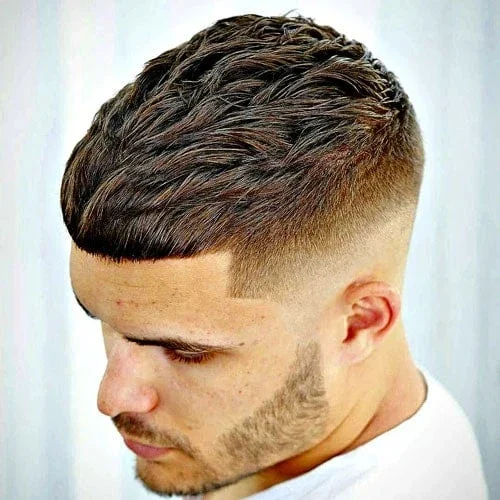
Short Forward Texture With a Straight Fringe
Dark pieces move forward into a short straight fringe. The boundary sits below the natural front opening, giving more forehead coverage than the open buzz and upright crop references.
- Shape
- Short forward texture
- Detail
- Straight front boundary
The upper surface remains separated and textured above that firm lower edge. A close side fade creates contrast beside the temple without adding width near the ear.
Wearability note: Compare the fringe endpoint carefully if coverage is your main concern. A lower fringe and a sharper boundary are separate choices, so specify how much forehead you want visible rather than requesting the label alone.
Idea 06
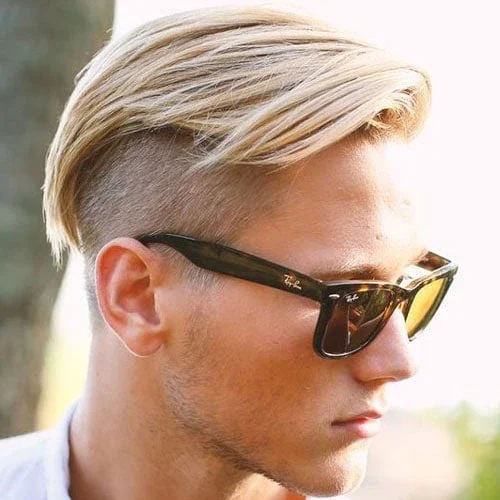
Long Light Sweep Above an Exposed Side
Long light strands sweep sideways and backward above an exposed short side. The front remains open, with the retained upper length creating direction rather than falling into a full fringe.
- Shape
- Long light side sweep
- Detail
- Exposed short side
Several ends separate near the crown, while the side sits close around the arm of the sunglasses. The contrast is therefore strong at the side even though the upper silhouette is relatively smooth.
Wearability note: Choose this if an open front and longer upper movement appeal to you. If you prefer more forehead coverage, compare a forward sweep instead of expecting this backward direction to provide it.
Idea 07
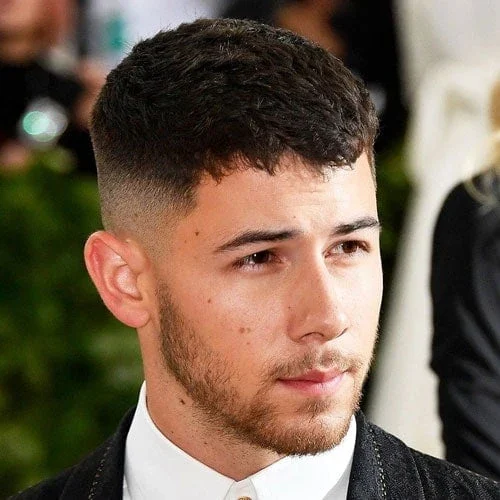
Short Soft Texture With a Broken Front
Short dark texture creates small bends above a broken front edge. A few pieces move toward the forehead, offering a little coverage without becoming a long fringe.
- Shape
- Short soft texture
- Detail
- Broken front edge
The side fade keeps the lower outline close and lets the small upper texture remain visible. The front boundary is less rigid than a sharply squared crop, with several uneven endpoints across the hairline.
Wearability note: Compare this with the straight-fringe example if you want a softer front. Both are compact, but the irregular boundary changes how the hair meets the forehead without requiring substantially longer sides.
Idea 08
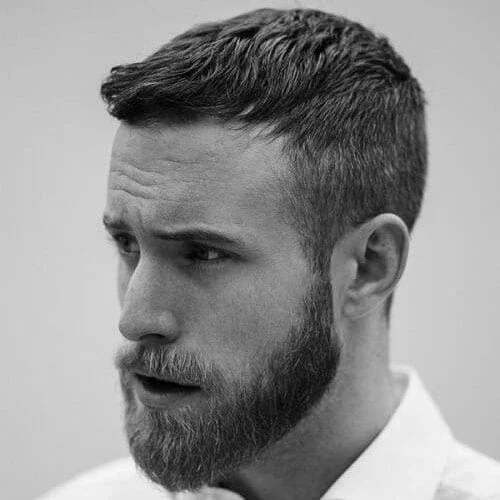
Low Side Sweep With Connected Short Sides
A low dark sweep moves sideways without adding much front height. The forehead remains open beneath a relatively smooth upper direction, making this a restrained alternative to a tall quiff.
- Shape
- Low sideways direction
- Detail
- Connected short sides
The sides retain short connected coverage rather than a broad exposed fade. The beard adds a separate lower outline, while the monochrome image emphasizes the haircut’s proportions over its exact color.
Wearability note: Use this to compare a low open-front option with a forward fringe. The direction across the forehead is the key difference; there is no need to assume either choice must suit everyone with similar proportions.
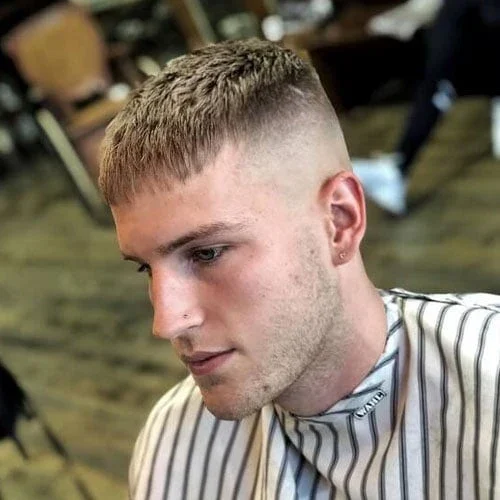
Idea 09
Compact Forward Fringe Above a High Close Side
A compact light-brown fringe points forward above a high close side. Its short uneven ends cover the upper forehead slightly without reaching down toward the eyebrows.
- Shape
- Compact forward fringe
- Detail
- High close side
The side transition rises high beside the temple, separating the darker short top from the exposed area below. The profile makes the contrast clear while showing how little the front projects.
Wearability note: Compare the short endpoint with a longer crop if you want more coverage. The high side can be changed independently, so decide whether the front length or the exposed side is the feature you prefer.

Idea 10
Short Raised Texture With an Open Hairline
Short brown strands rise above an open front hairline. The front has modest movement rather than a tall continuous ridge, keeping the overall profile compact.
- Shape
- Short raised texture
- Detail
- Open front hairline
The close sides contribute to the narrower outline beside the temples. The event photograph shows an exposed forehead clearly, offering a different direction from the fringe-heavy references in the gallery.
Wearability note: Choose this for the short upward texture if you like keeping the face open. The photograph is a shape comparison, not evidence that a particular forehead needs correction or a particular model has a stated measurement.
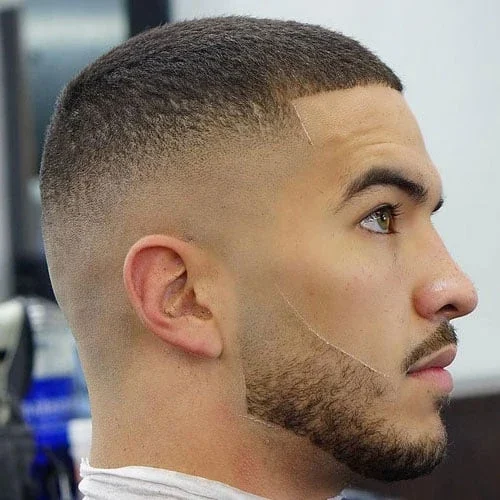
Idea 11
Very Short Crop With a Defined Corner
A very short dark crop sits above a defined temple corner and close side fade. The low upper length leaves the forehead exposed rather than relying on a forward fringe.
- Shape
- Very short upper crop
- Detail
- Defined temple corner
The profile shows the side transition and beard boundary clearly. Those sharp lower edges add structure, but they remain separate from the amount of hair retained above the forehead.
Wearability note: Compare this with a softer-edged close crop if precision at the temple is not your preference. A low open top can be retained without reproducing every line in the photographed beard and side boundary.
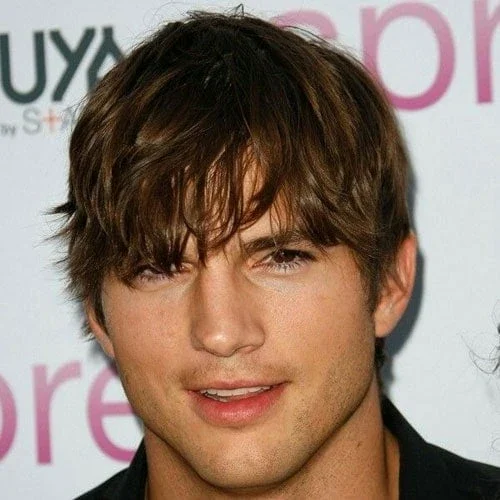
Idea 12
Long Broken Fringe With Ear-Level Coverage
Long brown pieces fall across much of the forehead in an irregular fringe. Small gaps remain between the strands, so the coverage is broken rather than a solid straight panel.
- Shape
- Long broken fringe
- Detail
- Retained side coverage
The sides retain visible length beside the face. That softer lower coverage distinguishes this from a similarly long fringe above an exposed undercut or a close high fade.
Wearability note: Use the fringe endpoint as the main reference if fuller forehead coverage appeals to you. Compare how close the longest pieces fall to the eyes, since that practical detail can matter more than the haircut name.
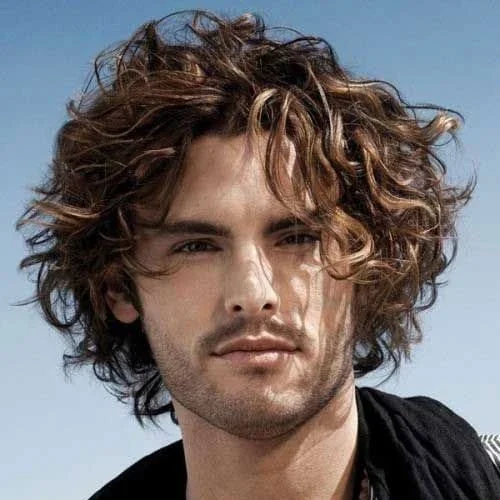
Idea 13
Loose Curls With an Open Central Gap
Loose brown curls fall around the face while leaving an opening near the center of the forehead. The front offers partial coverage rather than either a fully exposed hairline or a straight fringe.
- Shape
- Loose face-framing curls
- Detail
- Open central gap
Larger bends extend around the sides, adding width beyond the temples. Separated front curls create an irregular opening whose shape differs from the diagonal line of a side-swept fringe.
Wearability note: Compare the amount of side width with a more compact curly top if you prefer a narrower silhouette. The central opening and the fuller outer curls are distinct features that can be discussed separately.
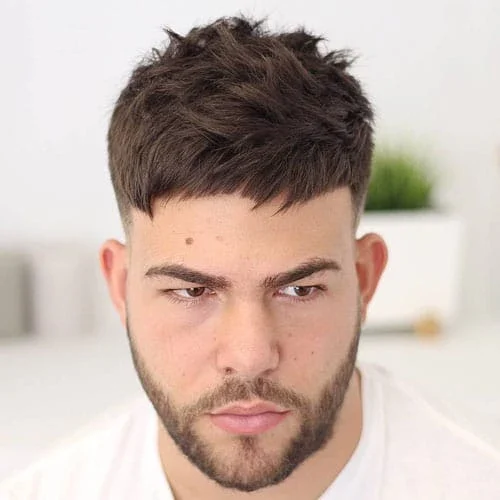
Idea 14
Short Diagonal Fringe With Broken Points
A short diagonal fringe crosses part of the forehead beneath broken upper points. The coverage is asymmetric, with more of the front left visible on one side.
- Shape
- Short diagonal fringe
- Detail
- Broken upper points
The sides remain closely contained without matching the longer front in length. The top has small raised sections behind the fringe, adding texture without a large rounded crest.
Wearability note: Choose the diagonal endpoint if you prefer partial coverage to a full straight fringe. A lower or longer version would change the eye-area coverage, so point out the shortest and longest front pieces.
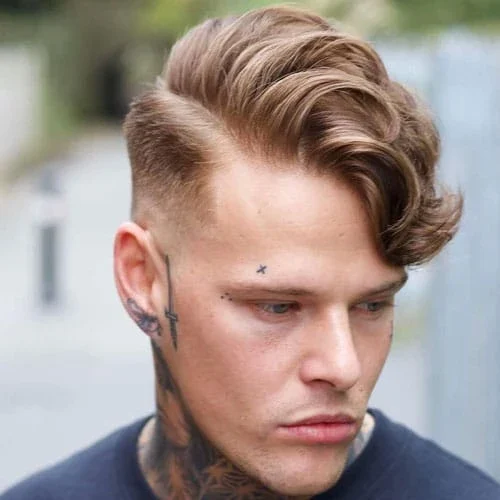
Idea 15
Long Light Side Wave Above a Close Temple
A long light-brown wave bends sideways and down near the forehead. The close temple keeps the lower width narrow, leaving the substantial upper section as the main source of movement.
- Shape
- Long light side wave
- Detail
- Close temple contrast
The front curves over to one side instead of forming a straight fringe across the face. The visible opening remains larger on the opposite side, creating distinctly uneven forehead coverage.
Wearability note: Compare the depth of that curve with a shorter side fringe before choosing. If you prefer less height, a lower upper shape could retain a similar sideways direction without the same rounded volume.
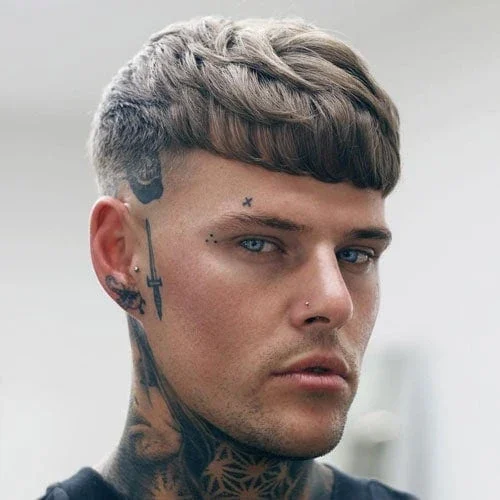
Idea 16
Rounded Crop With a Fuller Straight Fringe
A fuller light-brown fringe forms a relatively straight boundary across the forehead. The rounded upper section retains more coverage than the short broken crops, with shorter sides beneath it.
- Shape
- Fuller straight fringe
- Detail
- Rounded upper outline
The front appears heavier and more continuous than the loose separated fringes. The side transition keeps the lower silhouette contained while the upper shape curves around the head.
Wearability note: Use this to compare a denser-looking fringe boundary with a broken endpoint. The photograph shows coverage rather than proving density, and a barber can discuss how your own hair might sit at that length.
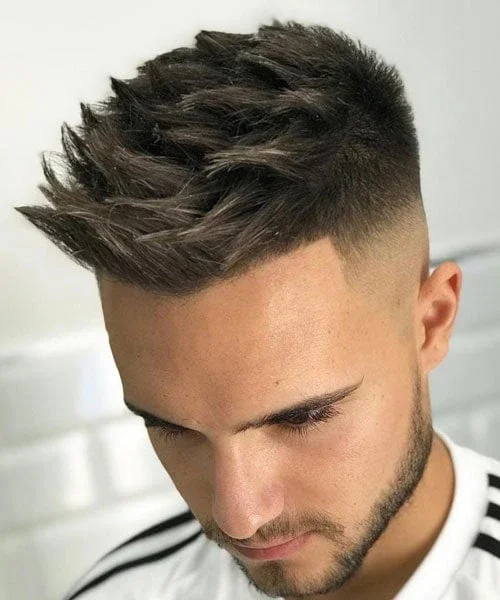
Idea 17
Short Sideward Points With a Raised Front
Short dark points move sideways and rise at the front, leaving the forehead open. The broken surface creates movement without the smooth continuous roll of a combed pompadour.
- Shape
- Short sideward points
- Detail
- Raised open front
The overhead angle makes the upper direction clear while understating some of the front height. Closely cut sides narrow the base beneath the longer textured section.
Wearability note: Compare a side view before deciding how much lift you want. This angle is useful for strand direction, but the visible forehead opening and the true height should be judged from more than one photograph.
Describe what you want visible
Tell your barber whether you prefer an open hairline, a short broken fringe or longer pieces near the eyebrows. There is no single forehead measurement that dictates one hairstyle for everyone.
Compare the front endpoint in more than one angle. A raised sweep can look lower from above, while a tilted portrait can make a short fringe appear to cover more than it does straight on.

About the author
Bella Ross
Bella Ross is the hairstyle editor behind Latest Easy Hairstyles. She curates practical haircut, braid, color, and styling ideas with a focus on looks that are easy to browse, realistic to recreate, and useful for everyday hair decisions.