
Product reviews / Combs for curly hair
Best Wide-Tooth Combs for Curly Hair: Six Reviews
Six wide-tooth combs reviewed for curly hair: wet detangling, curl grouping, dry volume, tooth layouts, comfortable grips and cleaning.

As an Amazon Associate I earn from qualifying purchases, at no extra cost to you. Affiliate disclosure

Choose when to separate
THE SHORTLIST
Match the comb to your curl routine
PATTERN covers wash-day preparation and deliberate dry fluffing; Ouidad adds a second tooth row, while Denman and KISMETICS offer larger formats.
PATTERN Wide Tooth Comb
Wash-day detangling and selective dry fluffing
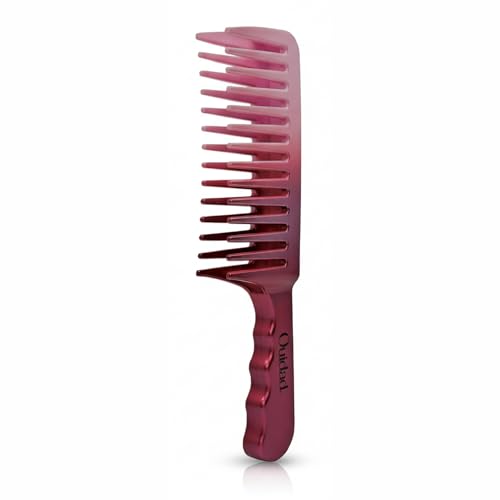
Ouidad Double Row Detangler
A double-row path through prepared curls

Denman D28 Wide Tooth Detangler
A large curved-tooth comb for wet curl preparation

Kitsch Detangle Wide Tooth Comb
A curved grip for ordinary wash-day sections

Paul Mitchell Detangler Comb
A simple straight-handled treatment comb

KISMETICS Big Hair Tools Extra Large Comb
A broad grip and wavy teeth for dense lengths
THE EDITOR'S TAKE
Detangling and finishing ask different things of a comb
PATTERN is the strongest fit when you want one comb for conditioned wash-day sections and selective dry separation. Ouidad is the double-row alternative; Denman D28 and KISMETICS offer larger bodies for prepared dense lengths. Kitsch and Paul Mitchell keep the everyday handling simpler.
The first decision is when you intend to comb. Opening knots before styling is a preparation job. Fluffing dry hair is a volume decision that changes curl grouping. Choosing the correct stage matters more than expecting widely spaced teeth to leave every finished curl untouched.
A CLOSER LOOK
The full product reviews
PATTERN Wide Tooth Comb
PATTERN gives the comb a wet-detangling role and a separate dry-volume role, with curl grouping deciding when the passes stop.
Choose the job before the first stroke
PATTERN gives this comb both a wet detangling role and a dry volume role. Those are different finishing decisions. On wash day, apply a compatible conditioner to divided wet sections, support the hair and begin at the ends. Once knots are open, stop the detangling passes and move to arranging your curl groups. Continuing to comb simply because the hair now travels easily adds handling without making the curl shape more settled.
Dry separation belongs where you want expansion
For a fuller dry finish, use the prongs selectively in an area where separation is welcome. A crown that needs lifting is a different target from a carefully formed curl at the front. Begin with a small movement and check the outline before working through another area. If you want individual curls to remain grouped and glossy, keep the comb away from those finished lengths and lift with fingers where possible.
Buy the standard tool for the sections you hold
This is the standard polycarbonate comb, rather than the mini or the wider PATTERN tool kit. The full body makes sense for a regular wash-day station; it is less compelling if a small handbag touch-up tool is the main need. Remove loose hairs and rinse away conditioner before storage. Its useful versatility comes from choosing when to detangle and when to fluff, not from expecting one stroke to do both without changing the hair.
What stands out
- The same tool can prepare wet sections and selectively separate dry curls.
- Wide-set prongs leave room for conditioned lengths.
The trade-offs
- A full comb-through on finished curls changes the grouping and can undo the shape you wanted to preserve.
Our verdict PATTERN is the clearest fit for a curl routine with two separate jobs: opening conditioned lengths before styling, then adding deliberate separation to dry curls when more volume matters than tightly grouped definition.
Using it in your routine
Use on sectioned, conditioned wet hair from ends upward. On dry curls, separate only the areas where you want more volume.
Consider another option if: You want to comb every dry curl while retaining the original clumps, or need a pocket-sized tool.
Ouidad Double Row Detangler
Ouidad’s second tooth row increases contact paths, so a small supported section needs to travel freely through both rows.
Two rows require a controlled section
The Double Row Detangler adds a second tooth path rather than simply making a single row wider. Spread a small, prepared section so the hair can travel between both rows. Begin with the released ends and advance toward the next area only when resistance has eased. If the hair bunches against the body, lift the comb out and divide the section. More contact points are not a reason to apply more force.
Keep product distribution to a useful minimum
Ouidad positions the design for distributing products with fewer strokes. Treat that as the purpose of the configuration rather than a guaranteed stroke count for every head of curls. Place conditioner or a suitable detangling product where the section needs slip, then comb only while it moves without tugging. A tight knot that sits near the nape needs attention from the supporting hand before the longer teeth are guided through it.
The extra tooth row also needs cleaning
Look between the rows when removing shed hair and rinsing the tool. Conditioner caught in that interior space is easier to miss than residue along one exposed tooth row. This is a useful dedicated preparation comb if you like its two-row handling. It is a less straightforward choice for a quick dry fluff: PATTERN states that role more clearly, while a plain single-row tool gives simpler access for selective separation.
What stands out
- Two tooth rows provide a distinct alternative to an ordinary single-row comb.
- Rounded tips and longer teeth suit a prepared curl section.
The trade-offs
- The extra row needs room to move; a thick unresolved section can load both rows at once.
Our verdict Ouidad makes sense when you specifically prefer two rows of rounded teeth for curl preparation. Keep the section small enough for both rows to travel freely; the design does not justify pulling through a knot.
Using it in your routine
Prepare curls with appropriate slip, support a small section and keep both rows aligned with the length. Rinse between the rows after use.
Consider another option if: You prefer the simplest single-row handling or regularly try to comb a whole dense section at once.
Denman D28 Wide Tooth Detangler
Denman D28 combines extra-wide curved teeth with a larger body for supported wet lengths rather than forcing a localized knot.
Give the curved teeth an open route
The D28 changes the contact path with curved, widely spaced teeth. Present the ends of a supported wet section to the tooth row rather than pushing the entire body into the roots. Keep the comb moving along the length without rotating it sideways through a resistant curl. If the outer hair releases but the center still catches, split that ribbon of hair before trying another pass. The curve does not make a hidden knot harmless.
Large is useful when the section is already manageable
Denman describes the D28 for thick, naturally curly wet hair and product distribution. Its large format can cover a prepared length without the tiny holding area of a pocket comb. It does not remove the first step of dividing dense hair. Around a short fringe or behind the ears, use less of the tooth row and support the ends closely; a broad body can feel less precise in those confined spaces.
Keep the D28 separate from a curl-styling brush
This is a comb, not the rubber-pad Denman brush used to arrange curls under tension. Finish detangling before switching to whichever styling method gives your preferred curl shape. Rinse around the tooth bases, leave the tool to dry and inspect any tooth that has struck a hard floor. The Blue Belle finish is a color choice; buying another D28 color does not add a different detangling mechanism.
What stands out
- Extra-wide teeth suit divided thick lengths.
- The large body is useful at a permanent wash-day station.
The trade-offs
- A large comb is less convenient around short fringe sections or in a small bag.
Our verdict The D28 is a roomy wash-day option for thick curly lengths. Choose it for its large working area and curved teeth, while keeping a smaller tool or fingers available for short, tightly localized tangles.
Using it in your routine
Use the curved teeth on divided wet lengths, entering from the ends. Finish knot removal before arranging curls with a styling brush.
Consider another option if: You mainly detangle tiny short sections or want a compact travel comb.
Kitsch Detangle Wide Tooth Comb
Kitsch changes the handhold with a curved grip, while the supporting hand remains above the curl ends being released.
Let the grip fit the way you support a curl section
The curve is the main handling distinction here. Hold the comb with the tooth row facing the prepared section and let your other hand support the hair above the working area. If the curved grip rolls in a conditioner-covered hand, rinse your fingers instead of tightening the grip and pushing harder. Someone accustomed to a straight handle may prefer Paul Mitchell even when both combs can do the same initial detangling job.
Untangling is not the same as keeping a finished clump
Wide gaps give curls room to pass, but combing still separates and rearranges the strands. Use that separation before styling, while conditioner or your chosen detangling product provides appropriate slip. Re-form curl groups afterward with the method that suits the finish you want. Running the comb through a dry, set front curl simply to tidy its surface can turn one group into several smaller pieces.
A manageable accessory still needs its own drying spot
Kitsch suits a routine in which the tool is rinsed and put away after the prepared sections are finished. Clear shed hairs before washing around the tooth bases so residue is not held beneath them. Store the comb where it can dry rather than underneath leaking bottles. Choose the curve because it gives you a comfortable working grip; choose PATTERN instead if dry separation for extra volume is an equally important part of the purchase.
What stands out
- A curved handle gives a different holding position from a straight stem.
- The open tooth row is straightforward to rinse.
The trade-offs
- The handle cannot compensate for excess conditioner making your hand slippery.
Our verdict Kitsch is a practical middle ground for routine curl detangling when a curved grip suits your hand. It is easier to justify for controlled everyday sections than for tackling a very broad mass of tangled hair.
Using it in your routine
Find a relaxed grip on the curved handle, open the conditioned ends and work upward in supported sections. Re-form curl groups after detangling.
Consider another option if: You want a straight-stem grip or expect combing to leave every finished dry curl undisturbed.
Paul Mitchell Detangler Comb
Paul Mitchell’s conventional handle keeps the supported curl section visible beside a single wide tooth row.
The straightforward handle leaves the section in view
A conventional handle lets you hold the comb beside the curl section while the supporting hand stays above the ends being opened. That simple layout makes it easier to notice whether resistance occurs at one point or across a whole ribbon of hair. Pause at that point and use fingers to investigate. Do not draw the full comb through the roots to check whether the section has become easier; judge the area you have just released.
A mask pass should follow knot removal
Paul Mitchell recommends the comb for distributing treatments and masks. First use the slip permitted by the product directions to free the ends. Only then make a longer, gentle distribution pass through the prepared length. If one area still lacks product, apply it directly with your hand rather than repeatedly dragging through the entire section. The comb moves coating through hair; it does not determine how much conditioner a curl routine needs.
Keep the dry role modest
Although the comb is intended for wet or dry hair, those descriptions do not make the same motion useful in every curl state. A loose, already separated dry section differs from a freshly set clump that you want to keep together. Choose this tool for a plain detangling and treatment task, and use a more selective technique when finishing dry curls. Rinse the tooth row after a mask and give the straight handle a clean, draining storage place.
What stands out
- A familiar handle keeps the holding decision simple.
- The open row works for distributing a treatment through released lengths.
The trade-offs
- Wide gaps can miss a small knot rather than fully open it.
Our verdict Paul Mitchell is the uncomplicated option when conditioner distribution and a familiar handle matter more than extra tooth rows, a large specialty shape or a separate dry-fluffing role.
Using it in your routine
Support the working length, release the ends first and distribute a mask only once that section moves freely.
Consider another option if: You need precise scalp parts or assume the widest gaps will catch every small single-strand knot.
KISMETICS Big Hair Tools Extra Large Comb
KISMETICS gives dense prepared ribbons a larger grip and wavy tooth layout, without removing the need to divide the hair.
The broad handle needs a broad enough task
The Big Hair Tools comb pairs an extra-large body with a wavy tooth layout. Its appeal is handling a manageable ribbon of long or dense hair with a grip that gives the hand more room. Keep the thumb and fingers on the body rather than pressing against the teeth. If your main difficulty is a few tightly tangled centimeters behind the ear, a large comb does not make that localized problem easier to reach.
Follow the tooth path rather than twisting through resistance
Align the wavy teeth with a divided, conditioned length and begin at the ends. Hair can collect against several parts of a shaped row if the section is too broad. Lift the comb clear before reducing the section size; twisting it within the knot changes the direction of tension without releasing the obstruction. Once the hair is free, decide how you want to rebuild the curl groups before applying the final styling layer.
Make room for the whole tool to drain
The handle cutout allows a hanging loop or suitable hook, but the larger body still needs clearance. Keep the tooth row away from bottles and the shower wall so it can rinse and drain. Inspect the edges after a fall and remove product around the wavy bases. This is a sensible large-format alternative to the Denman D28 when its grip and hanging arrangement suit your space; it is excessive for a tiny travel pouch.
What stands out
- The extra-large handle provides more holding area.
- A handle cutout gives an option for hanging storage.
The trade-offs
- The broad working area is cumbersome around a small knot or a short front section.
Our verdict KISMETICS is the format to consider when a small grip feels cramped and a broad comb suits your prepared dense sections. Its size is useful after dividing the hair, not as a shortcut around sectioning.
Using it in your routine
Use small enough sections for the wavy tooth row to travel freely, then hang or place the rinsed tool where the whole body can dry.
Consider another option if: You want a pocket comb or need a small head to work around short curl sections.
EVERYDAY DETAILS
What matters in everyday use
Curl stage
Detangling before styling and separating dry curls change the finish in different ways.
Tooth layout
A single row, curved teeth and a double row need different amounts of room within a section.
Grip and storage
A comfortable handle and a place to rinse and dry the tool matter on every wash day.
Product photographs: Amazon. Certain content that appears on this site comes from Amazon. This content is provided “as is” and is subject to change or removal at any time.
Finish the preparation before judging definition
Work with divided sections and suitable slip, supporting the hair above the area being opened. Start where the ends release and pause at resistance. Once the lengths are free, form the curl groups and apply the finishing products in your usual order. Extra combing does not replace that grouping step.
GOOD TO KNOW
Using a comb without losing the finish
Should I detangle before or after applying a curl gel?
Finish knot removal during preparation with a compatible conditioner or detangling product. Arrange the curl groups before the final gel layer. Combing through a dry gel cast changes those groups and can disturb the finish.
Do wide teeth keep every curl clump intact?
No. They leave more room than fine teeth, but a comb still separates strands. Use it before arranging defined curls, or deliberately in dry areas where you want more volume.
Is a double-row comb better for very dense curls?
It offers a different contact layout rather than a universal advantage. Ouidad needs a prepared section that can move freely through both rows. Divide the hair further when it bunches or catches.
Can a small knot slip between the teeth?
Yes. Check a point that still feels resistant with your fingers instead of assuming a smooth-looking pass has cleared every knot. Support the section and avoid pulling from the roots.
Bella Ross curates practical hairstyle ideas for everyday cuts, braids, color inspiration, and simple styling routines.
Our editorial policySTYLE IT YOUR WAY
A little styling inspiration
 Product reviews
Detangling Combs: 6 Detailed Product Reviews
A wide-tooth comb is useful for opening a prepared section and distributing conditioner. Its gaps can also move past a small knot, so a smooth-looking stroke is not proof every tangle is gone.
 Product reviews
Best Shower Combs: Wet Grip and Easy Storage
Six shower combs reviewed for wet grip, tooth shape, conditioner distribution and hanging storage, with practical knot-removal guidance.
 Product reviews
6 Curl Gels for 4C Hair: Our Detailed Reviews
PATTERN Strong Hold Gel is our first choice when structured hold is the priority. The Doux BIG POPPA suits a simpler clean-hair routine, while Carol’s Daughter Black Vanilla permits more flexible wet-or-dry restyling.