
Product reviews / Natural-hair brushes
Best Brushes for Natural Hair: Six Detailed Reviews
Six brush reviews for natural curls and coils, covering flexible detangling, curl grouping, section preparation and surface smoothing.

As an Amazon Associate I earn from qualifying purchases, at no extra cost to you. Affiliate disclosure

Flexible rows before styling
THE SHORTLIST
Natural-hair brushes worth a closer look
A natural-hair routine can need more than one kind of brush: a flexible detangler to prepare sections, a styling brush to organise curls, and a surface brush for a ponytail or updo. Felicia Leatherwood and BESTOOL serve detangling; Denman D3 adds deliberate styling tension. Here, natural hair means untreated curls and coils, rather than a brush made from wood or animal bristles.
Felicia Leatherwood Detangler Brush
Flexible rows before styling
BESTOOL Curly Hair Detangling Brush
Adjustable row support

Tangle Teezer Ultimate Detangler Naturally Curly
Firm-flex curl and coil detangling

Denman D3 Original Styler
Grouping already detangled curls

Wet Brush Original Detangler
Flexible individual pins

Goody Total Texture Smoothing Brush
Ponytail and updo surfaces
THE EDITOR'S TAKE
Best Brushes for Natural Hair
A natural-hair routine can need more than one kind of brush: a flexible detangler to prepare sections, a styling brush to organise curls, and a surface brush for a ponytail or updo. Felicia Leatherwood and BESTOOL serve detangling; Denman D3 adds deliberate styling tension. Here, natural hair means untreated curls and coils, rather than a brush made from wood or animal bristles.
A CLOSER LOOK
The full product reviews
Felicia Leatherwood Detangler Brush
Three-sided bonding allows the rows to move while a wide handle controls the brush.
The rows can move rather than stay boxed in
Felicia Leatherwood’s brush uses rows bonded on three sides rather than a rigidly enclosed pin bed. That construction allows the rows to move with the section. It is useful to consider before preparing hair for twists or braids, where you want to release tangles without asking a firm styling pad to pull the entire bundle through at once. The wide handle also leaves room for a deliberate grip while the other hand controls the section.
Prepare first, then choose the next styling step
Start at the ends of a manageable prepared section and move upward only as the lower part clears. If the rows meet a knot, stop and separate it rather than lean harder on the handle. Flexible movement is not a promise that brushing will be painless or prevent breakage in every situation. Once the section is detangled, you can decide whether to twist it, braid it or use a different tool for deliberate curl grouping. Felicia Leatherwood is the clearer choice when the job is preparing the section; it is less relevant when you only need to arrange a smooth outer layer on an already styled ponytail.
What stands out
- Three-sided bonding allows the rows to move.
- The wide handle provides a substantial grip while managing a section.
The trade-offs
- Flexible rows do not remove the need to separate a stubborn knot by hand.
Our verdict A flexible-row detangler for preparing curl and coil sections before twists, braids or further styling.
Using it in your routine
Work through a prepared manageable section from the ends upward, pausing where the rows meet resistance.
Consider another option if: Avoid forceful strokes through tightly tangled hair or using the brush to preserve a finished dry curl grouping.
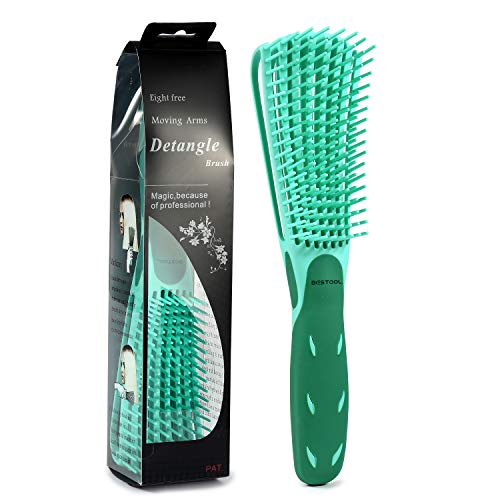
BESTOOL Curly Hair Detangling Brush
The removable support bar changes how firmly the eight comb arms are held.
The control bar is a functional difference
BESTOOL uses eight flexible comb arms with a support bar. With the bar fitted, the arms are held more firmly; without the same support they have more freedom to move. That is a meaningful choice to make before starting a section, rather than treating the accessory as spare packaging. A firmer arrangement can suit a controlled smoothing stroke, but it is not a reason to press through a knot that the loose arrangement resisted.
Its two directions serve different stages
The brand directs vertical work to release tangles, followed by horizontal work to smooth and define the prepared hair. That sequence makes more sense than repeatedly switching direction through an uncleared section. Keep the other hand supporting the hair while the brush works on a small area, especially before arranging twists or braids. The handle’s rubberised grip is useful to consider during product-coated section work, while the removable bar adds one more piece to keep clean and locate. Choose BESTOOL for adjustable row support and this two-stage routine; choose a fixed-pad detangler if you prefer fewer components and do not want to change the row response.
What stands out
- The control bar changes the support of the flexible arms.
- A rubberised handle offers a defined grip.
The trade-offs
- Firmer supported rows can feel different from freely moving arms; do not compensate with extra force.
Our verdict A row-style detangler when you want to change how firmly the arms are held during section preparation.
Using it in your routine
Use the brand’s vertical detangling approach first, then its horizontal smoothing approach only once the section clears.
Consider another option if: Skip it if you want a fixed pad and dislike adjusting a removable row-support bar.
Tangle Teezer Ultimate Detangler Naturally Curly
The curly edition uses firm-flex two-tier teeth; it is distinct from softer versions.
Buy the curly edition deliberately
This is the Naturally Curly Purple Passion edition, with firm-flex teeth aimed at curls and coils. It should not be confused with a softer Fine & Fragile edition or the ordinary straight-to-wavy version simply because the handle shape looks familiar. The longer teeth engage the section while the shorter teeth work nearer the surface. That fixed arrangement gives a different feel and response from the freely moving arms on a row-style brush.
A fixed head still needs separated sections
The tool can help distribute conditioner or styling product through a prepared section, but a large dense bundle can keep the inner hair beyond useful tooth contact. Work in manageable pieces and pause at resistance. The firmer teeth are a purchase consideration for fragile hair rather than proof that all natural textures need a firm brush. Remove shed hair after use and rinse away product buildup according to the maker’s care guidance so the tooth bed stays accessible. Choose this edition when a fixed head with firm-flex teeth matches your section work; choose softer pins or movable rows if that is the response your hair needs.
What stands out
- Long and short teeth have different roles within one head.
- No separate row-support bar is needed.
The trade-offs
- The firmer curly-hair teeth may not suit a fragile section that needs a softer response.
Our verdict A fixed-head detangler when you prefer firm-flex teeth over independently moving comb arms.
Using it in your routine
Divide the hair and work through the prepared section gradually, using the appropriate wet or dry routine in the brand’s directions.
Consider another option if: Avoid if firmer teeth feel unsuitable for your strand condition or you only want a soft surface brush.
Denman D3 Original Styler
Seven staggered pin rows create structured styling tension after detangling.
Styling tension is the reason to choose D3
Denman D3 has seven staggered rows of round-ended pins on a half-round pad. That structured path is useful when the task is arranging an already detangled curl section rather than only loosening knots. The pad gives the brush a more deliberate styling response than a freely moving-row head. Work out the direction you want the section to follow before beginning the stroke, rather than twisting the brush repeatedly through hair that is still tangled.
Definition begins with the prepared section
Separate and prepare the hair first, then use controlled strokes to organise the groups you want. A denser or more product-coated section may need to be divided so the inner hair follows the pins too. More tension is not automatically better definition, and the brush cannot guarantee a uniform curl pattern across differently responding strands. Its removable components also need to be reassembled correctly after cleaning; do not leave the pad or pins unevenly seated. Choose D3 for structured curl styling and section shaping. If the main problem is a stubborn tangle rather than curl arrangement, a flexible detangler is the more useful first stage.
What stands out
- Seven rows give a structured styling path.
- The half-round pad supports controlled direction through the section.
The trade-offs
- A styling pad creates a different amount of tension from a freely moving-row detangler.
Our verdict The styling choice for an already detangled section when you want deliberate tension and organised curl groups.
Using it in your routine
Detangle separately first, then use a controlled stroke on a prepared section for the curl arrangement you want.
Consider another option if: Skip it as your first tool for a tightly knotted section or when you want minimal styling tension.
Wet Brush Original Detangler
Individual flexible pins provide a conventional-head alternative to spreading comb arms.
A familiar head with flexible pins
Wet Brush Original uses individual IntelliFlex bristles in a conventional brush head. That is a useful alternative if you do not want a removable support bar or spreading comb arms. For natural hair, the practical question is whether the pins can reach through the section you have prepared. Dividing a dense bundle can make the contact more useful than repeatedly brushing the same outer layer. Start at the ends and control the hair with the other hand before working closer to the roots.
Detangling is different from heated styling
The Original is described for wet and dry detangling. That does not automatically make it a high-heat blowout brush or justify holding it in a dryer’s hot stream. Check the exact edition’s instructions if heated styling is your next step. It is useful for routine section preparation when you like a conventional handle and flexible individual pins, but it does not provide the deliberate pad tension of Denman D3 or the dense surface contact of a smoothing brush. Remove hair from the bristle bed and follow its cleaning instructions so product and loose strands do not obstruct the flexible pins.
What stands out
- Individual flexible pins offer a different response from supported comb arms.
- Wet and dry use gives more routine flexibility.
The trade-offs
- Dense bundles still need dividing so the interior reaches the pins.
Our verdict A flexible-pin alternative when you prefer a conventional brush head to a spreading-row design.
Using it in your routine
Support the prepared section, clear the ends first and progress upward without forcing the brush through knots.
Consider another option if: Avoid using it as a hot blowout brush unless the exact edition’s directions expressly permit that use.
Goody Total Texture Smoothing Brush
Dense vegan boar-style bristles arrange an already prepared outer layer.
The surface is its job
Goody Total Texture uses vegan boar-style bristles for smoothing a ponytail or updo. That label describes a synthetic bristle style rather than animal boar hair. Dense surface contact is useful when the hair underneath is already prepared and the job is directing flyaways or aligning the outer layer towards the fastening point. It is not the same job as separating a tangle inside dense curls, and pressing harder will not turn the brush into a deep detangler.
Finish without dragging the roots tight
Choose the direction of the ponytail or updo first, then use light strokes towards it while the other hand controls the gathered hair. Repeated hard brushing can add tension without solving an unsuitable fastening position. Work on the surface rather than brush out every finished curl when you only want a neater outline. Remove trapped strands and residue from the dense bristles after product-heavy styling. Goody is the useful second tool when a detangler has already prepared the hair; if you are buying only one brush to release knots, start with a flexible pin or movable-row design instead.
What stands out
- Dense bristles address the outer surface of the style.
- Vegan boar-style construction avoids animal bristles.
The trade-offs
- Surface smoothing is not a substitute for detangling dense curls underneath.
Our verdict The finishing brush for an already detangled ponytail or updo, rather than the tool for clearing interior knots.
Using it in your routine
Prepare and detangle the hair first, then use light directed strokes on the outer layer before securing the style.
Consider another option if: Choose a flexible detangler if knots within the section are the main problem.
EVERYDAY DETAILS
What matters in everyday use
Routine stage
Detangling, curl grouping and smoothing a ponytail are different brush jobs.
Pin response
Flexible rows and a firm styling pad change how the brush follows a section.
Section control
Prepare a workable section instead of forcing a brush through a whole dense bundle.
Product photographs: Amazon. Certain content that appears on this site comes from Amazon. This content is provided “as is” and is subject to change or removal at any time.
Detangle before asking a brush to shape
Work through knots before applying styling tension for curl grouping or preparing sections for twists and braids. A brush that organises an already detangled section is not automatically the best tool for releasing a knot. Stop and separate a stubborn tangle rather than dragging it through the pins.
A smoothing brush belongs on the surface
Dense short bristles can arrange the outer layer of a ponytail or updo, but they do not necessarily reach through dense curls to detangle them. For wood-pin or natural-bristle materials as the main purchase requirement, use the dedicated boar-bristle brush review and the broader brush selection. Material alone does not decide whether a brush fits a curl routine.
GOOD TO KNOW
Questions before you choose
Does natural hair need a natural-bristle brush?
No. Natural hair describes the untreated hair texture here. A flexible synthetic detangler can be a better match for releasing tangles than a dense natural-bristle surface brush.
Can one brush detangle and define curls?
Some can help with both, but the jobs use different amounts of tension. Release tangles first, then use controlled styling strokes if the brush and your section suit that purpose.
Should I brush a finished dry curl pattern?
That can separate the grouped curls and change their appearance. Choose whether you want to preserve the finished groups or reshape the hair before introducing the brush.
Is a firm brush better for dense curls?
Not automatically. Firm pins give a different response, while section size, preparation and the condition of the hair remain important. Resistance is a reason to pause, not push harder.
Bella Ross curates practical hairstyle ideas for everyday cuts, braids, color inspiration, and simple styling routines.
Our editorial policySTYLE IT YOUR WAY
A little styling inspiration
 Product reviews
4C Wash-Day Detangling Brushes: 6 Reviews
A wash-day routine may need a comb, moisture refresh and a smaller brush, not just a stronger bristle head. These picks have different roles when conditioner is already in the hair.
 Product reviews
6 Hair Brushes: Detailed Reviews
Wet Brush Original is our first choice for daily knots; Conair covers long lengths, while Kitsch and Framar serve different finishing preferences.
 Product reviews
6 Boar-Bristle Brushes: Detailed Product Reviews
Boar-bristle brushes are most useful when you want surface polish or hair gathered neatly in one direction. Pure soft bristles, nylon-reinforced mixtures and firm club brushes have different reach.