
Product reviews / Short-hair heatless curlers
Best Heatless Curlers for Short Hair: Five Reviews
Five unheated curler reviews for bobs and short layers, with small guides, independent placement, fastening and release advice.

As an Amazon Associate I earn from qualifying purchases, at no extra cost to you. Affiliate disclosure

Three-zone bob placement
THE SHORTLIST
Short-hair heatless curlers worth a closer look
Short hair needs a curler the shortest section can actually circle and fasten. Small independent satin pieces and foam rollers offer more placement freedom than a large across-head rod. For a bob, the useful decision is how you will capture the nape and front layers; a pixie may not have enough wrapping length at all.
BONNET QUEEN Small Satin Curlers
Three-zone bob placement
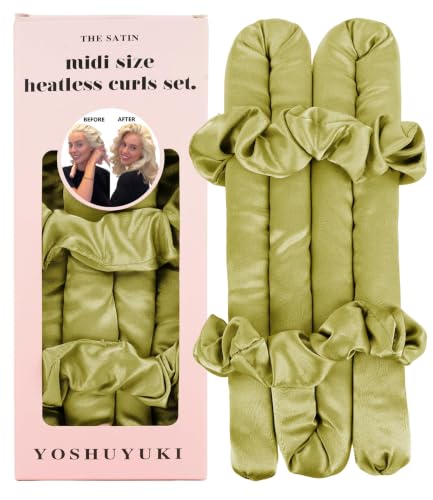
YOSHUYUKI Midi Satin Curling Rod
A narrower bob wrap

Conair 48-count Foam Rollers
Mixed-size short sections

xnicx 47-piece Flexi Rod Set
Small-diameter nape sections

Kitsch Satin Flexi Rods
Six satin-covered sections
THE EDITOR'S TAKE
Best Heatless Curlers for Short Hair
Short hair needs a curler the shortest section can actually circle and fasten. Small independent satin pieces and foam rollers offer more placement freedom than a large across-head rod. For a bob, the useful decision is how you will capture the nape and front layers; a pixie may not have enough wrapping length at all.
A CLOSER LOOK
The full product reviews
BONNET QUEEN Small Satin Curlers
Three separate pieces give the sides and back independent starting positions.
Small pieces give the bob a different layout
BONNET QUEEN supplies three small satin curlers with built-in scrunchies. That changes the arrangement from a single rod draped across the head: each piece can be positioned around the zone it needs to hold. It is especially useful to consider when the sides are long enough to wrap but the back needs its own starting point. Three pieces do not provide unlimited coverage, however. A dense bob may need smaller sections than the set can hold at once, and very short internal layers can still fall outside the arrangement.
Attached closures still need room
A built-in scrunchie keeps the fastening attached to the guide, which reduces the need to juggle loose ties while arranging the back. Leave enough of the guide accessible for that closure; winding hair over its fastening point can make the last step awkward. Spread the tips before securing them so a folded end does not begin with a crease. The brand positions the set for short and shoulder-length hair, but the actual wrap reach is the useful check. Choose it for a few independently placed satin zones, not as a promise that three pieces will capture every short haircut.
What stands out
- Three separate pieces allow different placement around the head.
- Built-in scrunchies keep the closure with its curler.
The trade-offs
- Three pieces may be too few for dense hair or many very short layers.
Our verdict Useful for a bob split into a few manageable zones when each zone can reach a small separate guide.
Using it in your routine
Separate the bob into workable zones, wrap each small guide and use its built-in scrunchie without folding the ends.
Consider another option if: Avoid if the short nape cannot circle a guide or you need many small individual sections.
YOSHUYUKI Midi Satin Curling Rod
The midi rod changes guide diameter; the shortest nape section still has to circle it.
A smaller curve is the reason to consider midi
The current YOSHUYUKI edition is the Midi Olive rod with a 0.99-inch diameter. That diameter is useful for a bob that struggles to circle a broad guide, or when the starting wrap you want is more compact. It is not proof of a fixed finished curl size. Section thickness and how much of the short ends can go around the guide remain central. Try the shortest part of the haircut in the intended placement before committing all the longer front sections.
The whole bob still needs to reach
A midi label can sound like a guaranteed short-hair fit, but a shorter guide and a shorter hair section are different measurements. The nape still needs enough length to wind and remain fastened; a heavily graduated bob can have much shorter pieces there than at the face. Avoid pulling those pieces across the head to make them reach. Keep the satin wrap orderly and release the hair by unwinding rather than dragging the guide through the set. This is the better type of choice when you want a smaller continuous guide, while independent foam or flexi rods offer more freedom for unequal lengths.
What stands out
- The 0.99-inch guide offers a smaller starting curve.
- The midi format gives a focused alternative to large guides.
The trade-offs
- The shorter format does not solve nape pieces that cannot make a complete turn.
Our verdict A smaller-diameter satin guide for a bob that has enough continuous length to wrap around it.
Using it in your routine
Check a nape section around the guide before arranging the full set, then keep the ends flat as you fasten.
Consider another option if: Skip it for a cropped nape or when you need independent rollers in several different positions.
Conair 48-count Foam Rollers
Four roller sizes let the fringe, crown and nape use different wrapping plans.
Many pieces let you respect the haircut
Conair’s set contains 48 foam rollers in four sizes, described in the current listing as approximately 0.7 to 1.3 inches. The useful feature for short hair is the ability to choose smaller guides at the nape and different ones around longer crown sections. You do not have to load a whole side of a bob onto one continuous rod. Small individual sections also make it easier to see whether the ends are flat before closing the frame.
Foam and frame behave differently
Each roller uses a plastic snap closure. That saves loose pins, but the frame is still a firmer piece than the foam cylinder. Place it deliberately if you intend to rest with the set in; a padded roller underneath does not guarantee that the closure will be unobtrusive. Do not press the frame over folded tips to force it shut. Release the snap completely and unwind the roller before moving to the next section. Conair makes sense when you need many independent positions and size choices, rather than the smallest possible number of pieces or an entirely fabric-only set.
What stands out
- Four sizes allow smaller guides at short sections.
- Individual snap closures do not require separate roller pins.
The trade-offs
- The plastic closure can sit against your head even though the roller itself is foam.
Our verdict The adaptable option for a bob with different lengths at the fringe, crown and nape.
Using it in your routine
Place smaller rollers where the ends have less wrapping reach and close each frame beyond the flat final turn.
Consider another option if: Avoid sleeping on a layout where the plastic frames press against your scalp.
xnicx 47-piece Flexi Rod Set
The small diameters help short sections circle a guide, while the seven-inch ends still need placement.
Choose diameter separately from rod length
The xnicx set contains 47 seven-inch flexi rods in seven colour-coded diameters, from 0.31 to 0.78 inch. The small diameters can be useful at a short nape because a section needs less hair to circle a narrow guide. The rods themselves are longer pieces, so the spare ends still need somewhere to sit. Choose by the wrapping curve first and then plan the bent-end placement; the two measurements solve different problems.
A bend is the fastening, not the styling tension
The rod ends bend to retain the section. Arrange the tips and the wrap before bending, rather than pulling the hair tighter to make the rod stay near the head. On a layered bob, separate pieces can sit where the layers actually reach instead of being stretched to a central headband. The large set also lets you use different diameters at the sides and crown, but more pieces mean more winding and removal steps. For this unheated routine, let the interior of the section finish setting before unbending and unwinding. Choose xnicx for diameter choice and independent positioning, not for a guaranteed overnight result.
What stands out
- Seven diameters offer a narrower range than large wrap rods.
- Bendable ends fasten without a separate plastic roller frame.
The trade-offs
- A small diameter does not mean the 7-inch rod will occupy little space once bent.
Our verdict A useful set for choosing a small guide around short sections and changing diameter across the haircut.
Using it in your routine
Smooth the tips around the chosen diameter and bend the free ends after the hair is arranged.
Consider another option if: Avoid it if you cannot place the bent rods away from your resting pressure points.
Kitsch Satin Flexi Rods
Six bendable guides offer independent satin-covered zones without a large tray of frames.
Six guides keep the layout manageable
Kitsch’s satin flexi set uses six independently placed bendable rods. Compared with a long across-head guide, that gives a bob more choices for the nape, side panels and crown. Compared with a large foam set, it keeps the number of pieces limited. Those are useful differences, but six guides can also be a constraint on a dense bob. If you have to make each section very thick to fit the whole head, the inner layers may be harder to arrange and to check before removal.
Satin needs a deliberate first turn
The smooth cover does not grip the initial wrap in the same way as a textured surface. Start with the ends flat, keep the section controlled and bend the guide once the wrap is in place. Do not rely on extra root tension to hold a short layer that does not reach. The current Kitsch description particularly positions the flexible retention for medium-to-thick hair; very fine slipping pieces are a reason to consider another fastening system. Choose these rods when six satin-covered zones fit your bob comfortably, rather than assuming the same six-piece plan will work on every density or a cropped pixie.
What stands out
- Six separate guides allow independent bob placement.
- The satin-covered rods bend to retain the arranged section.
The trade-offs
- Six guides may not be enough when dense short hair needs many small sections.
Our verdict A middle ground between a continuous headband and a large tray of individual foam rollers.
Using it in your routine
Place each rod where the section reaches, smooth the ends around it and bend to retain without tight roots.
Consider another option if: Choose a larger roller set if six sections leave too much hair crowded on each guide.
EVERYDAY DETAILS
What matters in everyday use
Shortest section
Measure suitability by the piece you want wrapped at the nape, not the longest front layer.
Placement
Separate curlers let you choose a different position for the fringe, sides and crown.
Closure
A clip, bend or scrunchie needs room beyond the wrapped ends to hold them.
Product photographs: Amazon. Certain content that appears on this site comes from Amazon. This content is provided “as is” and is subject to change or removal at any time.
A bob and a pixie need different expectations
A short bob can have enough length for small rollers while a cropped nape does not. Leave pieces that cannot make a secure turn rather than stretching them tightly across the scalp. These recommendations use no powered heating stage; they are not hot rollers or thermal brushes.
Plan the set around the haircut
Start with the sections most likely to escape. Choose smaller guides for those pieces, keep the ends flat and avoid covering a fastener with a neighbouring section. For resting or sleeping, assess where each frame or bent rod lands; soft padding does not remove every pressure point.
GOOD TO KNOW
Questions before you choose
Can these curlers work on a pixie?
Only on sections long enough to wrap and fasten. A very short nape may remain outside the set; no roller can create wrapping length that the haircut lacks.
Do I need the smallest roller everywhere?
No. Use the smaller guide where short pieces need it and a larger one where the hair reaches comfortably. One diameter across the entire head can ignore the haircut’s different lengths.
Can I use a dryer to speed up this routine?
This page focuses on unheated setting. If you choose to add heat, you are changing that routine and must check the curler’s own heat instructions rather than assume every foam or satin piece tolerates it.
Why do the ends look bent?
An end folded under the closure starts with a sharper bend. Spread the last turn flat and keep the closure beyond it before leaving the set in.
Bella Ross curates practical hairstyle ideas for everyday cuts, braids, color inspiration, and simple styling routines.
Our editorial policySTYLE IT YOUR WAY
A little styling inspiration
 Product reviews
6 Curlers for Short Hair: Our Detailed Reviews
Annie’s half-inch snap rollers lead this shortlist because the small diameter suits short sections. Conair’s mixed self-grip sizes offer more variety; the compact Remington set works best when the top is long enough for one-inch rollers.
 Product reviews
Best Heatless Curling Rods: Four Wrap Systems
Four heatless curling rod reviews covering satin wraps, guide diameter, extra length, anchoring and secure end placement.
 Style inspiration
15 Ways to Style Short Hair
A photo-first guide to ways to style short hair, with concise image-specific notes and practical comparison points.