
Product reviews / Hair straighteners
Hair Straighteners for Damaged Hair: Cautious Choices
No straightener repairs damage. If direct heat remains part of your routine, compare minimum settings, section access and release control before coating claims.

As an Amazon Associate I earn from qualifying purchases, at no extra cost to you. Affiliate disclosure

Heat choice before coating claims
THE SHORTLIST
The dryers worth a closer look
No straightener repairs damage. If direct heat remains part of your routine, compare minimum settings, section access and release control before coating claims.
Our first pick
Remington Shine Therapy 1-inch
Small dry-hair sections
Our first pick
Wavytalk Steam Sesh
Optional steam workflow
Narrow dual-purpose styling

ANNLARY 1-inch Flat Iron
Visible eight-step control

TYMO RING Straightening Comb
Comb-format smoothing

BaBylissPRO Digital Nano Titanium One-Inch
Repeatable digital selection
Straighten and bend

L’ange Le Ceramique
Rounded-edge shaping
THE EDITOR'S TAKE
The first decision is whether direct heat belongs in the routine
Damaged hair can need less handling and a different styling routine, rather than another hot tool. These reviews explain the controls and contact formats worth checking if you are still choosing an iron; no model is a universal safe choice for weakened strands.
A CLOSER LOOK
The full product reviews
Our first pick
Remington Shine Therapy 1-inch
Shine Therapy is a narrow-plate option for deliberate small sections; it does not repair damaged strands.
Remington Shine Therapy 1-inch: working contact
The useful way to approach the S9511 is as a section-by-section styling tool. On a bob, separate the lower layer from the crown so you can straighten the underside without repeatedly pressing the already-styled top. Its 1-inch width is a practical fit for that work: you can take a smaller front section without trying to balance it across a broad plate. Leave clearance from the scalp and keep the iron moving rather than holding it at the roots.
For bent-under ends, the movement changes near the bottom of the section. Guide the lengths through first, then use a small wrist turn as the ends exit. A strong turn halfway down can create an unintended bend through the body of the style. This width makes the straight-to-curved transition more manageable than a wide head, although it does not establish whether your hair will straighten in one pass.
Remington Shine Therapy 1-inch: selected setting and release
Select an appropriate setting before starting and use the temperature lock according to the supplied instructions. That matters when you rotate your grip to shape the ends: a locked setting removes one avoidable variable while your attention is on the section. The range begins at 300°F, so this is not our recommendation for someone specifically replacing an iron because they need a setting below that point.
The argan-oil and keratin language describes the plate coating. It does not tell you how much shine you will see, how the tool will glide through your particular hair, or whether damaged ends will look healthier. Treat those outcomes separately from the verifiable control features. If the section catches, stop and check detangling, section size, and plate cleanliness instead of assuming more heat will fix it.
Narrow plates and fragile ends
One-inch plates are relevant when the haircut contains fragile short pieces or ends you want to handle separately. A smaller contact area gives placement control, but does not itself prove lower damage. Keep the section visible, avoid forcing a catch through the plate edge and stop reworking a piece after the shape is made. Argan-oil and keratin plate language is not a conditioning treatment delivered into the strand. Choose this iron for controlled geometry if direct heat remains appropriate for the hair’s condition, rather than buy it expecting the Shine Therapy name to mend damage.
What stands out
- Versatile 1-inch plates
- Adjustable temperature with a lock
- Automatic shutoff
The trade-offs
- Less coverage than a wide-plate iron
- 300°F starting setting may be higher than you want
Our verdict Shine Therapy is a narrow-plate option for deliberate small sections; it does not repair damaged strands.
Using it in your routine
Use only on fully dry prepared hair and avoid repeatedly passing over already-shaped ends.
Consider another option if: Skip heat styling when the strand condition cannot tolerate the routine.
Our first pick
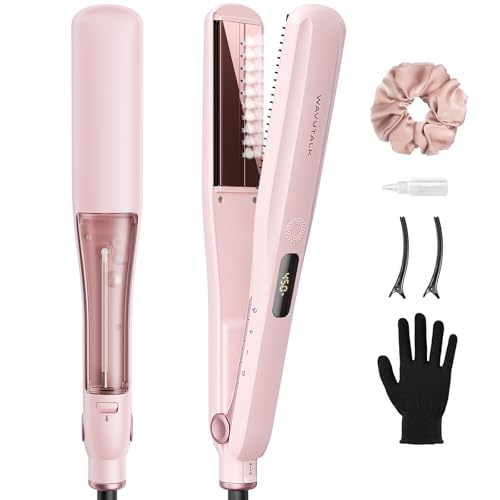
Wavytalk Steam Sesh
Steam Sesh adds water and a removable comb to the styling sequence; those features do not make damaged hair heat-proof.
Wavytalk Steam Sesh: working contact
A water reservoir and removable comb change the workflow. The maker specifies distilled or purified water and a comb-down orientation; those details matter more in daily use than a promise of a salon-equivalent result. Steam is emitted when the plates close.
Wavytalk Steam Sesh: selected setting and release
Steam Sesh has five specific choices: 300, 340, 370, 410 and 450°F. The 1.38-inch titanium plates work with a reservoir and a removable comb, so the preparation includes filling with distilled or purified water and checking comb orientation. Wavytalk says the comb should face down; turning it the other way can change how hair enters the teeth. Steam is emitted when the plates close. This is a dry-hair plate routine with an added steam function, not permission to clamp ordinary wet hair or add oils to the reservoir.
The extra comb deserves a cautious choice
Damaged ends can make the removable comb the important decision. Its teeth provide guidance, but a catch should prompt release and preparation rather than more pulling. The instructions specify the comb-facing-down orientation, so practise the grip cool. A reservoir creates another upkeep step and does not convert this into a wet-hair straightener. Choose steam only within the product instructions and keep repair claims outside the decision. Someone wanting the simplest cautious routine may prefer a conventional plate iron with fewer moving parts and no water handling.
What stands out
- 1.38-inch titanium plates
- Five settings from 300–450°F
The trade-offs
- The reservoir adds upkeep and weight, and the 300°F minimum is not especially low.
Our verdict Steam Sesh adds water and a removable comb to the styling sequence; those features do not make damaged hair heat-proof.
Using it in your routine
Follow permitted-water instructions and prepare a dry detangled section before choosing steam and comb use.
Consider another option if: Skip the comb where weakened ends catch, and do not treat steam as permission for repeated passes.
Narrow dual-purpose styling
ANNLARY 1-inch Flat Iron
- Format
- Titanium/ceramic plate design
- Controls / design
- Dual-voltage styling format
ANNLARY offers displayed temperature choices, with a 320°F minimum that may rule it out for a cautious routine.
ANNLARY 1-inch Flat Iron: working contact
The one-inch rounded body supports straightening or a bend through the ends. Keep the strand thin enough for both surfaces to meet, then release cleanly before rotating the body for a curl. The title’s titanium/ceramic combination should not be treated as a reason to increase heat; use the selected model’s actual controls and directions.
ANNLARY 1-inch Flat Iron: selected setting and release
ANNLARY describes titanium and ceramic together rather than solid ceramic plates. Its one-inch width and rounded body suit detailed smoothing and a turn through the ends. That makes it more adaptable around layers than the two-inch Revlon, but slower across broad long ribbons. Confirm the selected listing’s construction and controls so the ceramic label is not doing more work in the decision than the actual working shape.
The starting temperature matters more than the top setting
The stated 320–450°F range is central for damaged hair because the lowest available choice is a real limit. Eight settings and a visible display provide repeatability, but do not establish that the first setting is appropriate for every weakened strand. The silicone exterior area assists the grip; it does not make heated plates safe to press near skin or catch a section. Choose the floating one-inch format only when both the starting range and contact method fit the hair’s condition. A larger control count cannot compensate for a minimum you cannot use.
What stands out
- Titanium/ceramic plate design
- Dual-voltage styling format
The trade-offs
- The one-inch face covers less width than a broad iron, and the plate description combines titanium and ceramic.
Our verdict ANNLARY offers displayed temperature choices, with a 320°F minimum that may rule it out for a cautious routine.
Using it in your routine
Check the selected setting before placing a fully dry section between the plates.
Consider another option if: Skip this model if its 320°F minimum is already too high for your intended routine.
TYMO RING Straightening Comb
TYMO RING changes the contact format to heated teeth; choose it for that handling method rather than a damage-reduction promise.
TYMO RING Straightening Comb: working contact
TYMO RING uses a three-dimensional heated tooth layout rather than close two plates over the strand. The teeth guide the prepared section as the hand moves, changing the contact and grip compared with an ordinary flat iron. Its exterior shield assists handling, but heated working surfaces still need clearance from skin.
TYMO RING Straightening Comb: selected setting and release
The five setting choices let you select from the supplied control menu, while the thirty-minute inactivity shutoff is a backup feature. It is not a reason to leave the tool connected after the styling session. Keep the tooth area clear of residue according to the cleaning instructions and allow it to cool before storing.
Heated teeth are still direct heat
The brush format can appear gentler than a clamped plate because the hand movement resembles ordinary brushing. Its working teeth are heated, so the routine still requires a considered setting and a prepared section. Avoid dragging a damaged tangle through the head or resting the teeth at a stop. Five heat choices are useful only when their available range meets the intended routine. Choose this design when guiding strands through teeth is easier for you than coordinating clamped plates, with the same need to assess whether direct heat belongs in the routine at all.
What stands out
- Comb-guided straightening format
- Five setting choices
The trade-offs
- Heated teeth still require fully prepared sections
Our verdict TYMO RING changes the contact format to heated teeth; choose it for that handling method rather than a damage-reduction promise.
Using it in your routine
Prepare dry detangled hair and keep the heated teeth away from skin while guiding a small section.
Consider another option if: Skip the comb format when delicate ends catch or when avoiding direct heat is the better routine.
BaBylissPRO Digital Nano Titanium One-Inch
BaBylissPRO Digital adds a memory setting for a deliberate routine, but the saved setting still needs checking.
BaBylissPRO Digital Nano Titanium One-Inch: working contact
This digital BaBylissPRO uses one-inch Nano Titanium plates with an all-directional floating construction. The smaller width is useful for placing a panel without needing the broad coverage of a two-inch iron. Floating contact lets the plates respond to the section, but does not make a knot or thick folded panel suitable for clamping.
BaBylissPRO Digital Nano Titanium One-Inch: selected setting and release
The display supports a chosen temperature up to the specified 450°F ceiling, and the memory function saves a preferred setting. Read the selected value before every use rather than infer it from the previous session. The high ceiling gives range; it does not establish that every available setting belongs in a routine for fragile strands.
A remembered setting is a starting point to check
A memory function can help someone return to a chosen setting, but damaged hair can change after coloring, trimming or another treatment. Read the display rather than automatically trust yesterday’s preset. The one-inch floating plates give a controlled contact format, while the high 450°F ceiling is not the reason to consider it here. Separate fragile ends from stronger root growth if the styling method and condition allow a different approach. Choose this model for visible repeatable selection, not because titanium branding or a saved number establishes safety for every strand.
What stands out
- Visible digital selection
- Memory setting for a chosen routine
The trade-offs
- The high heat ceiling is not a suitability guarantee
Our verdict BaBylissPRO Digital adds a memory setting for a deliberate routine, but the saved setting still needs checking.
Using it in your routine
Check the display on each use instead of assuming the remembered setting suits the current section.
Consider another option if: Skip high presets or repeated smoothing passes on weakened ends.
Straighten and bend
L’ange Le Ceramique
Le Ceramique suits a planned bend or straight finish; one-pass marketing should not become a pressure or heat target.
L’ange Le Ceramique: working contact
The rounded body can guide a bend after the straightening pass, but only when the strand can release without snagging. Begin with a thin dry section and move through the ceramic face steadily. For a curved end, turn the body near the lower length rather than gripping the root and twisting the full strand tightly around the tool.
L’ange Le Ceramique: selected setting and release
Le Ceramique is useful when straightening and a curved end belong in the same routine. Its rounded body lets you guide the lower length into a bend without switching to a wand. That technique depends on a section that can slide and release neatly. Choose it for the shape flexibility, while remembering that a rounded exterior does not remove the need to control heat and strand tension.
Plan the turn before the fragile section reaches it
Rounded edges let the plate body create a bend as well as a straight finish. That is useful when a damaged haircut needs only a small end shape rather than a full high-heat straightening session. Plan the release so the ends are not held against the surface while you decide which way to turn. The ceramic coating does not repair the hair, and the one-pass label is not a requirement to complete a difficult section at higher heat. Choose the shape for a specific controlled job, with fewer unnecessary repeated passes as the practical priority.
What stands out
- Ceramic flat iron
- Rounded styling body
The trade-offs
- Rounded-body curling takes practice; dense long lengths require several narrow sections.
Our verdict Le Ceramique suits a planned bend or straight finish; one-pass marketing should not become a pressure or heat target.
Using it in your routine
Practise the intended turn while cool and use the selected setting on dry prepared hair.
Consider another option if: Skip tightly winding fragile ends or pursuing a one-pass claim by raising heat.
EVERYDAY DETAILS
What matters in everyday use
Working format
No straightener repairs damage. If direct heat remains part of your routine, compare minimum settings, section access and release control before coating claims.
Handling
Compare the grip, adjustment and included parts you will actually use.
Product photographs: Amazon. Certain content that appears on this site comes from Amazon. This content is provided “as is” and is subject to change or removal at any time.
Separate a styling effect from repair
A shinier or straighter appearance is not repaired damage. Do not use ceramic, keratin, steam or protection wording to justify a temperature or repeated exposure that the hair cannot tolerate.
GOOD TO KNOW
Questions before you choose
Can a straightener repair damaged ends?
No. It can alter the temporary shape, while an infused plate or steam feature does not mend a split end.
Is the lowest setting always suitable?
No. Minimum temperatures differ by model, and even a lowest option may be unsuitable for a weakened strand.
Does a memory setting remove the need to check heat?
No. Read the display each time and reconsider the setting when the hair’s condition or styling method changes.
Bella Ross curates practical hairstyle ideas for everyday cuts, braids, color inspiration, and simple styling routines.
Our editorial policySTYLE IT YOUR WAY
A little styling inspiration
 Style inspiration
15 Ways to Style Short Hair
A photo-first guide to ways to style short hair, with concise image-specific notes and practical comparison points.
 Style inspiration
29+ Curly Hairstyles for Various Occasions
A photo-first guide to curly hairstyles for various occasions, with concise image-specific notes and practical comparison points.
 Style inspiration
29+ Fine Hair Hairstyles
A photo-first guide to fine hair hairstyles, with concise image-specific notes and practical comparison points.