
Product reviews / Styling tools
Fine-Hair Flat Irons: 6 Detailed Reviews
For fine hair, adjustable low heat is more useful than a very high ceiling. A one-inch iron also gives more precise section placement than a broad plate designed around coverage.

As an Amazon Associate I earn from qualifying purchases, at no extra cost to you. Affiliate disclosure

Fine-strand routines needing low starting heat
THE SHORTLIST
The six products at a glance
Different working designs for low-end temperature choice for fine strands.
Our first pick
TYMO Sway Light Pink
Fine-strand routines needing low starting heat
Pick 2

Remington Shine Therapy 1-inch
Straightening and shaping ends with one-inch plates
Pick 3
Conair Double Ceramic 1-inch
Straightforward controls and extra-long one-inch plates
Pick 4
Hot Tools Black Gold 1.25-inch
Mid-width plates and many digital settings
Pick 5

VANESSA PRO 1-inch Titanium Iron
One-inch handling with lower starting heat
Pick 6

ANNLARY 1-inch Dual-PTC Iron
A conventional one-inch digital routine
THE EDITOR'S TAKE
The details that matter in daily use
For fine hair, adjustable low heat is more useful than a very high ceiling. A one-inch iron also gives more precise section placement than a broad plate designed around coverage.
A CLOSER LOOK
The full product reviews
Our first pick
TYMO Sway Light Pink
A temperature menu cannot guarantee a strand tolerates heat; start low and avoid repeatedly reheating the same ends.
Plate shape and placement
The Light Pink Sway combines a familiar one-inch working width with a low starting setting. That low starting point is the reason to consider it when control matters more than wide-plate coverage or a fixed-temperature routine.
The controls that matter
Sway Light Pink offers 32 choices from 140 to 450°F in a one-inch titanium format. Start by selecting the lower level you intend to use, then check the display again before moving from healthier lengths to delicate ends. The small working width leaves room for a narrow panel without making this a pencil iron. It can straighten or turn the section, but those are different hand movements. Having many settings is useful only if you use the low end deliberately; it is not a requirement to work through the menu during a session.
Fine-strand considerations
Sway’s 140°F start is the clearest reason to consider it for fine strands. You can select a lower level without resorting to a fixed-hot iron and hoping faster movement will compensate. The one-inch head keeps the panel small enough to see while leaving room for a gentle end turn. Choose it for temperature latitude; the 32-step menu is unnecessary only if you prefer a much shorter preset routine.
What stands out
- 1-inch titanium plates
- 32 settings from 140–450°F
The trade-offs
- A temperature menu cannot guarantee a strand tolerates heat; start low and avoid repeatedly reheating the same ends.
Our verdict Sway’s 140°F start is the clearest reason to consider it for fine strands.
Using it in your routine
Use fully dry, detangled sections. Check the 32 settings from 140–450°f before a continuous pass and keep the working head away from skin.
Consider another option if: A temperature menu cannot guarantee a strand tolerates heat; start low and avoid repeatedly reheating the same ends.
Pick 2
Remington Shine Therapy 1-inch
Its starting temperature is higher than some adjustable alternatives; fragile hair deserves a lower-starting option.
Plate shape and placement
The one-inch plates are a manageable middle ground for smoothing lengths and turning the ends. The digital heat choice is more useful than the oil-and-keratin coating story: infused plates do not replace conditioner or a heat protectant.
The controls that matter
Nine temperature choices make the Shine Therapy more adjustable than a two-setting basic iron. Confirm the digital setting before starting the next panel; Turbo is a separate high-heat option, not a normal stage of every pass. The one-inch width leaves room to straighten a ribbon of hair and then turn the wrist for a shaped end. Remington lists a nine-foot cord and a one-hour automatic shutoff. Those are useful handling and session details, while the coating is not a replacement for your usual preparation products.
Fine-strand considerations
Shine Therapy is more adjustable than a basic two-setting iron, but its heat menu should be judged against the low-starting alternatives rather than its nine-choice count alone. The one-inch geometry is useful for a small fine-hair panel and a lightly shaped end. The infused ceramic story is secondary: fine strands do not need extra passes to make use of an argan-oil or keratin-branded coating.
What stands out
- 1-inch ceramic plates
- Nine heat settings
The trade-offs
- Its starting temperature is higher than some adjustable alternatives; fragile hair deserves a lower-starting option.
Our verdict Shine Therapy is more adjustable than a basic two-setting iron, but its heat menu should be judged against the low-starting alternatives rather than its nine-choice count alone.
Using it in your routine
Use fully dry, detangled sections. Check the nine heat settings before a continuous pass and keep the working head away from skin.
Consider another option if: Its starting temperature is higher than some adjustable alternatives; fragile hair deserves a lower-starting option.
Pick 3
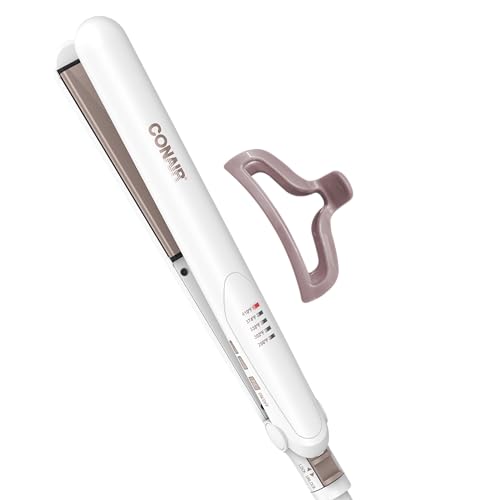
Conair Double Ceramic 1-inch
- Working format
- 1-inch extra-long ceramic plates
- Controls
- Five heat settings up to 410°F
Extra plate length is less convenient when only a very short nape section needs attention.
Plate shape and placement
The one-inch width gives a manageable grip on a flat section, while extra plate length supplies more contact area. That is useful for arranging hair evenly before closing the tool instead of squeezing a bunched section.
The controls that matter
Conair’s CS221AMZ uses five heat settings up to 410°F and one-inch extra-long floating plates. The length matters when a panel needs room to spread along the working face; it does not require you to take a thick section. The included claw clip is useful for holding unfinished panels out of the way while the current piece is arranged. Learn the selected setting and closing movement before the first pass. Unlike a fixed-hot switch-only iron, there is some choice, but the listing’s maximum should not be confused with a verified low minimum.
Fine-strand considerations
Conair offers a short five-choice menu and extra-long one-inch contact, a straightforward combination for spreading a fine panel before closing. Plate length is useful when hairs bunch against a smaller working area. The listing establishes the 410°F maximum but not a precise lower minimum in this review’s evidence. If a particular low setting is essential to your choice, confirm that range before selecting it over a clearly documented low-starting model.
What stands out
- 1-inch extra-long ceramic plates
- Five heat settings up to 410°F
The trade-offs
- Extra plate length is less convenient when only a very short nape section needs attention.
Our verdict Conair offers a short five-choice menu and extra-long one-inch contact, a straightforward combination for spreading a fine panel before closing.
Using it in your routine
Use fully dry, detangled sections. Check the five heat settings up to 410°f before a continuous pass and keep the working head away from skin.
Consider another option if: Extra plate length is less convenient when only a very short nape section needs attention.
Pick 4
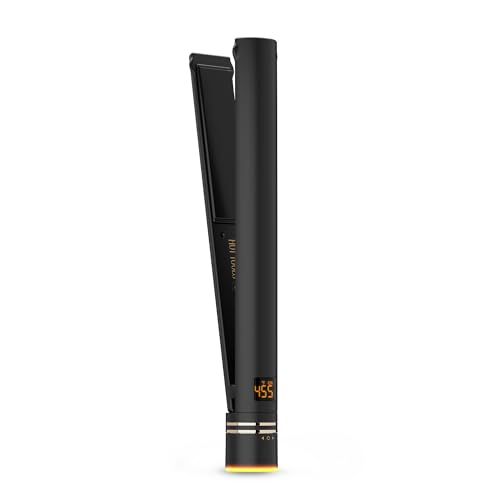
Hot Tools Black Gold 1.25-inch
Its styling versatility depends on controlled sectioning; the coating does not guarantee a snag-free pass.
Plate shape and placement
The working width sits between a detail iron and a broad two-inch tool. Rounded edges make it plausible for a wrist turn at the ends, while a digital display helps keep the chosen setting consistent across the session.
The controls that matter
Hot Tools gives this Black Gold model 27 digital heat levels and a ceiling of 455°F. Its 1.25-inch floating plates sit between the familiar one-inch width and a broad coverage iron, with rounded edges for turning the ends as well as smoothing them. Choose the displayed setting before that turn: the wrist movement should change the shape, not become an opportunity to hold the heated head in one spot. Universal dual voltage and a two-hour shutoff are listed features. The longer shutoff interval should not be mistaken for permission to leave a session unattended.
Fine-strand considerations
Black Gold’s many digital levels are useful when you want the selected setting to remain clear through a fine-hair session. Its 1.25-inch face is broader than the one-inch models, so isolate the front pieces rather than allowing the head to collect neighboring hairs. The rounded outline supports an end bend, but it is not the most local format for a very short fringe or a small section beside the part.
What stands out
- 1.25-inch floating plates
- 27 digital heat levels
The trade-offs
- Its styling versatility depends on controlled sectioning; the coating does not guarantee a snag-free pass.
Our verdict Black Gold’s many digital levels are useful when you want the selected setting to remain clear through a fine-hair session.
Using it in your routine
Use fully dry, detangled sections. Check the 27 digital heat levels before a continuous pass and keep the working head away from skin.
Consider another option if: Its styling versatility depends on controlled sectioning; the coating does not guarantee a snag-free pass.
Pick 5
VANESSA PRO 1-inch Titanium Iron
The manufacturer’s one-pass wording is not a result guarantee for any particular texture.
Plate shape and placement
Compared with the two-inch version, this one-inch iron puts more emphasis on handling smaller sections and shaping the ends. Its 265°F starting point provides more low-end choice than a fixed-hot iron.
The controls that matter
The one-inch VANESSA PRO has eleven selectable settings from 265 to 450°F, displayed electronically. That gives a lower start than several wide or compact alternatives without requiring a very narrow detail plate. The titanium surface is paired with a conventional straightening-and-turning format, so keep the panel flat before closing and choose the end movement before it reaches the head. The catalog also lists 100–240V support. Do not import the two-inch model’s coverage into this review simply because both carry the same brand and temperature range.
Fine-strand considerations
VANESSA begins at 265°F, below several 320°F-minimum irons but above TYMO Sway’s 140°F start. That comparison is relevant for fine strands in a way the 450°F ceiling is not. Its one-inch titanium face is manageable for visible small panels, and eleven choices leave less menu navigation than 32. Select it for that combination of familiar width and lower-end adjustment, while considering a still lower-starting tool for especially delicate areas.
What stands out
- 1-inch titanium plates
- 11 settings from 265–450°F
The trade-offs
- The manufacturer’s one-pass wording is not a result guarantee for any particular texture.
Our verdict VANESSA begins at 265°F, below several 320°F-minimum irons but above TYMO Sway’s 140°F start.
Using it in your routine
Use fully dry, detangled sections. Check the 11 settings from 265–450°f before a continuous pass and keep the working head away from skin.
Consider another option if: The manufacturer’s one-pass wording is not a result guarantee for any particular texture.
Pick 6
ANNLARY 1-inch Dual-PTC Iron
The 320°F minimum limits the appeal for fine, bleached or easily stressed hair.
Plate shape and placement
This variant begins at 320°F, so its digital controls do not offer the low starting point of the TYMO Sway. Dual heaters and a temperature sensor are design features; neither makes a fragile strand suitable for high heat.
The controls that matter
This ANNLARY version uses dual PTC heaters, an NTC temperature sensor and a displayed 320–450°F range. The extra heating and sensing mechanisms concern temperature regulation; they do not create a low starting choice below 320°F. Its one-inch floating plates suit a prepared ribbon of hair, with a rounded body for end shaping. Select the displayed setting before closing and keep the movement separate from the control changes. The 60-minute shutoff is an additional session feature. Make the buying decision on the actual range, not just the number of heater or sensor abbreviations.
Fine-strand considerations
ANNLARY Dual-PTC is the most qualified fine-hair choice here because its menu begins at 320°F. Dual heaters and a monitoring sensor concern heat regulation, not the ability to select a cooler level. The one-inch floating plate is workable for small panels, but the controls cannot supply the temperature latitude of a low-starting iron. If reduced heat is the reason you are shopping, that limitation matters more than the heater terminology.
What stands out
- 1-inch floating plates
- 320–450°F adjustable heat
The trade-offs
- The 320°F minimum limits the appeal for fine, bleached or easily stressed hair.
Our verdict ANNLARY Dual-PTC is the most qualified fine-hair choice here because its menu begins at 320°F.
Using it in your routine
Use fully dry, detangled sections. Check the 320–450°f adjustable heat before a continuous pass and keep the working head away from skin.
Consider another option if: The 320°F minimum limits the appeal for fine, bleached or easily stressed hair.
EVERYDAY DETAILS
What matters in everyday use
For this review, we prioritized low-end temperature choice for fine strands. Manufacturer performance promises are treated as claims; the purchase judgments focus on the documented design and how it fits the routine.
Starting temperature
Useful low settings rather than high maximum heat
Control and placement
A working head you can place deliberately, with controls that are clear during the session.
Care and storage
The practical work required to clean, cool when needed, and keep the tool ready for its next session.
Product photographs: Amazon. Certain content that appears on this site comes from Amazon. This content is provided “as is” and is subject to change or removal at any time.
A workable section comes first
Do not raise the temperature simply because one end looks less polished. Check product residue, section size and dryness first, then decide whether any more heat is needed.
Before styling and after the session
Use ordinary plate irons on fully dry, detangled hair. Select the setting before the section enters the head and leave room around skin. Open a resistant knot by hand instead of pressing the plates harder or reheating the same patch.
Unplug after styling and allow the working head to cool. Remove residue using the maker’s cleaning method, without immersing an electrical tool or scraping its coating. Keep the cord loosely stored.
GOOD TO KNOW
Questions about this styling routine
Is a low starting temperature useful for fine hair?
Yes, it gives you room to begin cautiously. TYMO Sway and L’ange Aplatir start lower than several compact or high-minimum models; a high maximum is not the main advantage for fine strands.
Does a ceramic coating make a high minimum cooler?
No. ANNLARY’s menu still begins at 320°F regardless of coating or heater features. Compare the actual starting setting with clearly documented lower-starting alternatives.
Bella Ross curates practical hairstyle ideas for everyday cuts, braids, color inspiration, and simple styling routines.
Our editorial policySTYLE IT YOUR WAY
A little styling inspiration
 Haircut guide
24+ Choppy Bob Hairstyles for Fine Hair That Add Texture
A photo-first guide to choppy bob hairstyles for fine hair, from textured chin bobs and stacked bobs to wispy bangs, shaggy layers, and piecey ends.
 Style inspiration
15 Bob Haircut Ideas with Bangs
A photo-first guide to bob haircut ideas with bangs, with concise image-specific notes and practical comparison points.
 Style inspiration
29+ Asymmetrical Bob Haircuts
A photo-first guide to asymmetrical bob haircuts, with concise image-specific notes and practical comparison points.