
Product reviews / Straightening tools
6 Ceramic Flat Irons: Detailed Reviews
Ceramic flat irons include solid-ceramic descriptions, ceramic coatings and combined titanium/ceramic constructions. Those are not identical materials.

As an Amazon Associate I earn from qualifying purchases, at no extra cost to you. Affiliate disclosure

Versatile ceramic styling
THE SHORTLIST
Our six picks at a glance
Check the exact construction and controls instead of treating every ceramic-labeled iron as equivalent.
Versatile ceramic styling
Remington Shine Therapy 1-inch
One-inch versatility with an adjustable heat menu.
Straighten and bend

L’ange Le Ceramique
A rounded ceramic body for smoothing and end bends.
Simple fixed-heat control
CHI Original 1-inch
A simple switch with a fixed-temperature limit.
Narrow dual-purpose styling

ANNLARY 1-inch Flat Iron
A narrow rounded iron with combined-material plates.
Wide coated plates

Revlon Ceramic Coated 2-inch
Broad ceramic-coated plates for length coverage.
Long narrow plates
Conair Double Ceramic Flat Iron
Extra contact length without two-inch width.
THE EDITOR'S TAKE
Check the exact construction and controls instead of treating every ceramic-labeled iron as equivalent
Ceramic flat irons include solid-ceramic descriptions, ceramic coatings and combined titanium/ceramic constructions. Those are not identical materials. The buying decision still depends on usable heat settings, plate width and how you shape the ends; a ceramic label alone cannot establish a gentler or more consistent result.
A CLOSER LOOK
The full product reviews
Versatile ceramic styling
Remington Shine Therapy 1-inch
One-inch versatility with an adjustable heat menu.
The one-inch Shine Therapy is the more versatile size for straightening, a slight end curve or a loose turn through the lengths. Its floating-plate design helps the surfaces meet around a thin section. The infusion is part of the coating; it should not be treated as a leave-in conditioner or a reason to iron a section repeatedly.
Controls and section placement
The one-inch floating plates suit a thin moving pass or a light end turn. Choose among the nine listed heat settings and keep the section dry and orderly; the infusion is not a reason to apply more heat. Around the fringe, reduce the ribbon width so the plate edges do not catch neighboring pieces as you change angle.
What this version suits
Shine Therapy’s one-inch plates suit smoothing a layered section and making a light turn at the ends. Nine settings offer a more adaptable starting point than a fixed-temperature iron. Its floating faces need a thin ribbon to meet cleanly; a thicker bundle does not gain even contact simply because the plates move. The narrower size trades broad-length coverage for more local shaping control.
What stands out
- 1-inch ceramic-coated plates
- Nine temperature settings
The trade-offs
- It is slower across dense long hair than a wider iron.
Our verdict It is slower across dense long hair than a wider iron.
Using it in your routine
The one-inch floating plates suit a thin moving pass or a light end turn.
Consider another option if: It is slower across dense long hair than a wider iron.
Straighten and bend
L’ange Le Ceramique
A rounded ceramic body for smoothing and end bends.
Le Ceramique pairs ceramic plates with a rounded body for smoothing or making a bend. The rounded exterior is useful when you want an end curve without switching to a wand. The shape supports a controlled turn near the lower length, while a straight moving pass remains the simpler approach through the rest of the section.
Controls and section placement
The rounded body can guide a bend after the straightening pass, but only when the strand can release without snagging. Begin with a thin dry section and move through the ceramic face steadily. For a curved end, turn the body near the lower length rather than gripping the root and twisting the full strand tightly around the tool.
What this version suits
Le Ceramique is useful when straightening and a curved end belong in the same routine. Its rounded body lets you guide the lower length into a bend without switching to a wand. That technique depends on a section that can slide and release neatly. Choose it for the shape flexibility, while remembering that a rounded exterior does not remove the need to control heat and strand tension.
What stands out
- Ceramic flat iron
- Rounded styling body
The trade-offs
- Rounded-body curling takes practice; dense long lengths require several narrow sections.
Our verdict Rounded-body curling takes practice; dense long lengths require several narrow sections.
Using it in your routine
The rounded body can guide a bend after the straightening pass, but only when the strand can release without snagging.
Consider another option if: Rounded-body curling takes practice; dense long lengths require several narrow sections.
Simple fixed-heat control
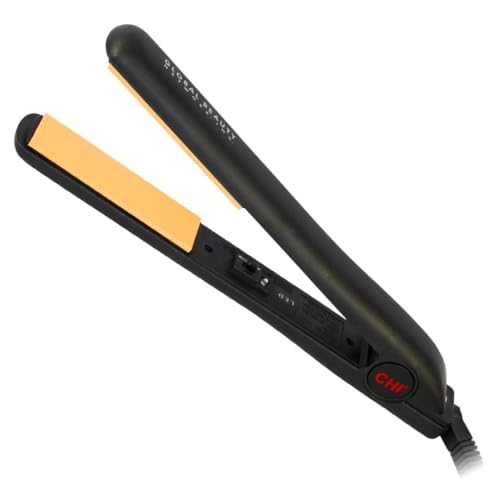
CHI Original 1-inch
A simple switch with a fixed-temperature limit.
CHI Original keeps setup simple with an on/off switch and a fixed 392°F temperature. That simplicity is attractive if your hair tolerates the setting, but it is a substantial limitation if you need to start lower. Its one-inch floating plates and rounded body support straightening and shaping without a heat menu.
Controls and section placement
The on/off switch heats the iron to a fixed 392°F, so there is no lower-start adjustment to select. Decide whether that suits the strand before using the tool. Use the one-inch floating plates on a thin dry section, guiding a moving pass; if your routine needs a lower setting, choose an adjustable iron instead.
What this version suits
CHI Original removes heat-menu decisions with a fixed 392°F setting. That is convenient only if the temperature suits the prepared section; a delicate fringe cannot be assigned a lower setting on this model. The one-inch floating plates provide useful local access and a rounded turn. For mixed-condition hair, an adjustable iron may be more practical than using the same fixed heat across every area.
What stands out
- 1-inch ceramic floating plates
- Fixed 392°F setting
The trade-offs
- No adjustable temperature; unsuitable when your routine needs a lower setting.
Our verdict No adjustable temperature; unsuitable when your routine needs a lower setting.
Using it in your routine
The on/off switch heats the iron to a fixed 392°F, so there is no lower-start adjustment to select.
Consider another option if: No adjustable temperature; unsuitable when your routine needs a lower setting.
Narrow dual-purpose styling
ANNLARY 1-inch Flat Iron
- Format
- Titanium/ceramic plate design
- Controls / design
- Dual-voltage styling format
A narrow rounded iron with combined-material plates.
ANNLARY lists a one-inch straightener that also shapes curls with its rounded body. The title describes titanium and ceramic together, so treat it as the advertised combined construction rather than asserting solid ceramic plates. One-inch width favors detail and end shaping, with less length coverage than broad irons.
Controls and section placement
The one-inch rounded body supports straightening or a bend through the ends. Keep the strand thin enough for both surfaces to meet, then release cleanly before rotating the body for a curl. The title’s titanium/ceramic combination should not be treated as a reason to increase heat; use the selected model’s actual controls and directions.
What this version suits
ANNLARY describes titanium and ceramic together rather than solid ceramic plates. Its one-inch width and rounded body suit detailed smoothing and a turn through the ends. That makes it more adaptable around layers than the two-inch Revlon, but slower across broad long ribbons. Confirm the selected listing’s construction and controls so the ceramic label is not doing more work in the decision than the actual working shape.
What stands out
- Titanium/ceramic plate design
- Dual-voltage styling format
The trade-offs
- The one-inch face covers less width than a broad iron, and the plate description combines titanium and ceramic.
Our verdict The one-inch face covers less width than a broad iron, and the plate description combines titanium and ceramic.
Using it in your routine
The one-inch rounded body supports straightening or a bend through the ends.
Consider another option if: The one-inch face covers less width than a broad iron, and the plate description combines titanium and ceramic.
Wide coated plates
Revlon Ceramic Coated 2-inch
Broad ceramic-coated plates for length coverage.
Revlon’s two-inch iron is a broad ceramic-coated option for smoothing longer lengths. The coating distinction matters: ceramic-coated plates should not be described as solid ceramic. A large face can cover more width, but the hair still needs a thin prepared section that lets both surfaces meet evenly.
Controls and section placement
Use the two-inch coated plates through longer ribbons rather than short fringe details. The listed maximum is 400°F, with the heat choice matched to the prepared section rather than coverage width. Keep the pass moving, and choose a narrower tool when the strand is too short to sit squarely between the large faces.
What this version suits
Revlon’s two-inch coated plates suit prepared longer lengths where a broad ribbon can sit squarely inside the face. The 400°F maximum does not give the same range as an iron whose menu reaches higher, but maximum heat alone is not the useful comparison. Its size is the decisive feature: broad coverage at the lengths, with less access for short roots and precise curved fringe work.
What stands out
- 2-inch ceramic-coated plates
- Heat up to 400°F
The trade-offs
- The broad plate format is awkward on short roots and curled fringe.
Our verdict The broad plate format is awkward on short roots and curled fringe.
Using it in your routine
Use the two-inch coated plates through longer ribbons rather than short fringe details.
Consider another option if: The broad plate format is awkward on short roots and curled fringe.
Long narrow plates
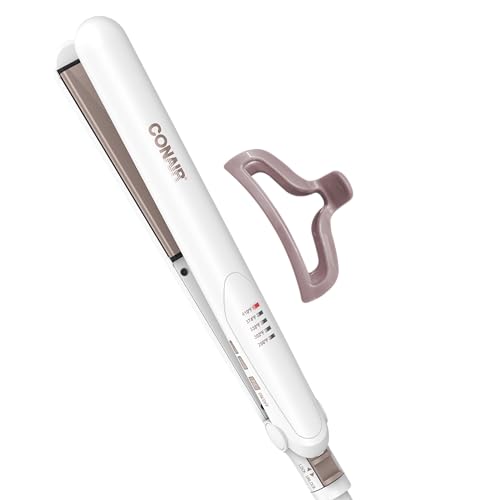
Conair Double Ceramic Flat Iron
Extra contact length without two-inch width.
This Conair version combines one-inch width with extra-long plates and five heat settings. The length increases contact space without making the head as wide as a two-inch iron. That is a useful compromise when you want to work through lengths but still turn the ends or reach a layered section.
Controls and section placement
The one-inch extra-long plates add contact length without widening the head. Choose among five settings up to 410°F, arrange the section with the supplied clip if useful, then make a moving pass. Extra length does not allow a thicker bundle: the ribbon still needs to sit evenly between the floating plates.
What this version suits
Conair’s one-inch extra-long plates give the section more contact space while keeping a relatively narrow face. That suits a layered length where you want coverage and still need to turn the ends. Five settings provide a stepped choice up to 410°F, with fewer fine adjustments than a detailed digital range. Keep the ribbon thin despite the longer plates so the hair lies evenly between them.
What stands out
- 1-inch extra-long plates
- Five settings up to 410°F
The trade-offs
- Five presets offer fewer small adjustments than a detailed digital range.
Our verdict Five presets offer fewer small adjustments than a detailed digital range.
Using it in your routine
The one-inch extra-long plates add contact length without widening the head.
Consider another option if: Five presets offer fewer small adjustments than a detailed digital range.
EVERYDAY DETAILS
What matters in everyday use
Remington Shine Therapy 1-inch
One-inch versatility with an adjustable heat menu. It is slower across dense long hair than a wider iron.
L’ange Le Ceramique
A rounded ceramic body for smoothing and end bends. Rounded-body curling takes practice; dense long lengths require several narrow sections.
CHI Original 1-inch
A simple switch with a fixed-temperature limit. No adjustable temperature; unsuitable when your routine needs a lower setting.
Product photographs: Amazon. Certain content that appears on this site comes from Amazon. This content is provided “as is” and is subject to change or removal at any time.
Putting the tools into your routine
Use dry detangled hair and a thin section that lets the plates meet evenly. Begin with an appropriate lower setting when available, keep the pass moving, and release cleanly at the ends. A rounded one-inch tool supports a bend; wide plates favor coverage through longer lengths.
Cleaning and storage
Clean cooled plates only as the maker directs, without abrasive scraping. Keep hairs and residue out of the closing path. Store narrow detail irons where their plate edges cannot be knocked, and give broad irons enough space to protect their faces and cord.
GOOD TO KNOW
Your practical questions
Should I choose wide or narrow plates?
Wide plates favor coverage through longer prepared sections. Narrow plates give more placement control on short layers and ends. Neither replaces thin sectioning or an appropriate heat setting.
What makes Remington Shine Therapy 1-inch the first pick?
Its 1-inch ceramic-coated plates and nine temperature settings suit the main routine covered here. Check the exact construction and controls instead of treating every ceramic-labeled iron as equivalent.
What should I check before ordering?
Confirm the exact product version, included parts and operating instructions on the selected listing. Do not assume similarly named versions have identical controls or dimensions.
Bella Ross curates practical hairstyle ideas for everyday cuts, braids, color inspiration, and simple styling routines.
Our editorial policySTYLE IT YOUR WAY
A little styling inspiration
 Style inspiration
28+ Blunt Bob Ideas
A photo-first guide to blunt bob ideas, with concise image-specific notes and practical comparison points.
 Style inspiration
29+ Hairstyles for Bob Haircuts
A photo-first guide to hairstyles for bob haircuts, with concise image-specific notes and practical comparison points.
 Style inspiration
15 Ways to Style Bangs in Summer Heat
A photo-first guide to ways to style bangs in summer heat, with concise image-specific notes and practical comparison points.